
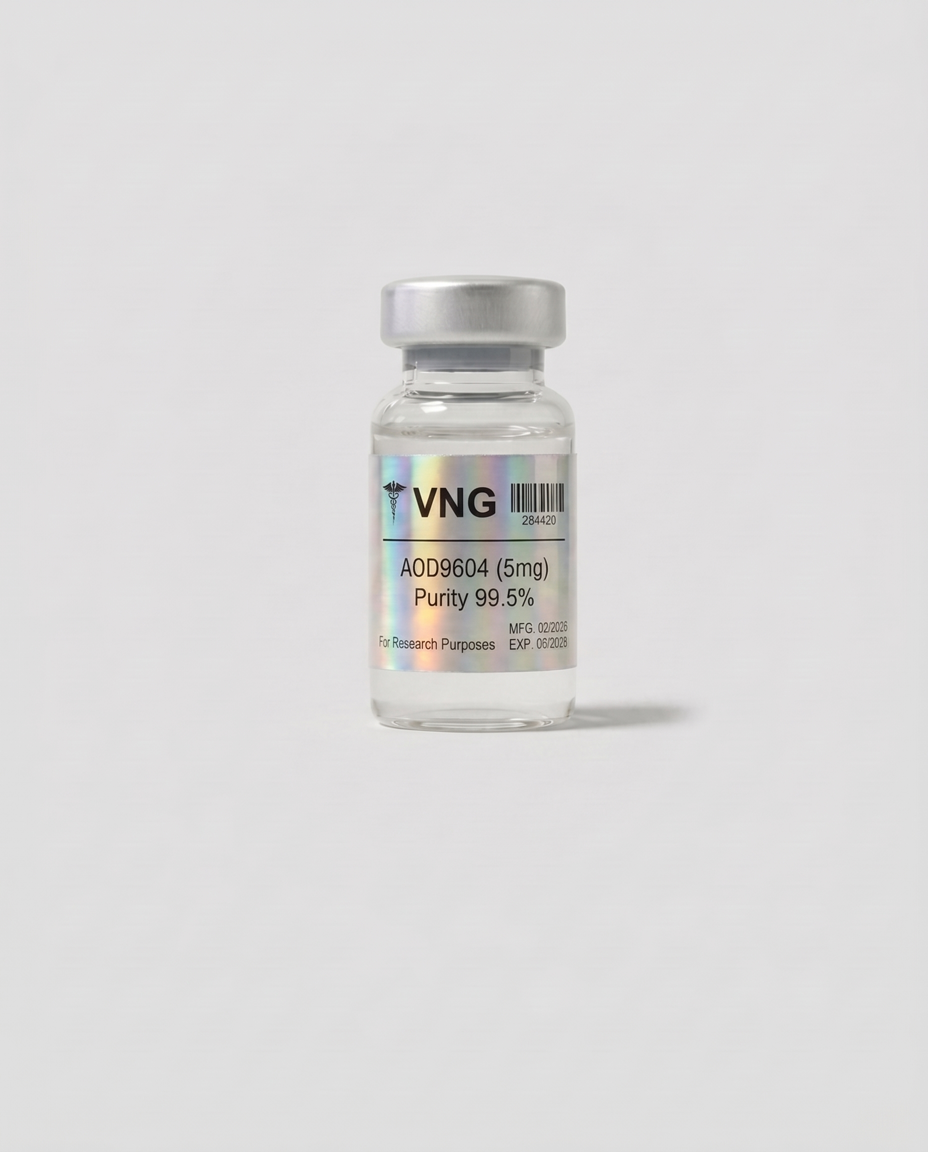
For research & educational purposes only. This article is a neutral, procedural reference for laboratory / in-vitro research handling — not medical advice or a usage recommendation. These materials are not for human or animal consumption.
On this page
What AOD9604 is
AOD9604 is a modified fragment of human growth hormone corresponding to residues 176-191 of the parent molecule, with an added cysteine so the peptide forms a stabilising disulfide bridge. It is supplied as an analytical-grade reference material for laboratory research.
Where it comes from
In the 1990s researchers at Monash University in Australia mapped the metabolic effects of growth hormone to its C-terminal region and made a synthetic fragment, hGH 177-191, capped with a tyrosine and later cyclised for stability. Metabolic Pharmaceuticals developed it as AOD9604 (Anti-Obesity Drug 9604), and a 2004 review in Current Opinion in Investigational Drugs records the programme as it moved through clinical trials.
What it does — in plain terms
Growth hormone does many things; the idea behind AOD9604 was to isolate just the piece thought to act on fat metabolism. In obese mice the fragment increased fat oxidation, and that finding launched a clinical programme in the early 2000s. In people the body-weight trials did not reach their goals and the programme was stopped. Later research moved to joints, with a rabbit osteoarthritis model, and to anti-doping laboratories, which needed to detect it.
How it works
The parent hormone raises fat breakdown (lipolysis) and lowers fat storage in adipose tissue. The 176-191 fragment was chosen because it carried that activity in cell and animal work without the growth-promoting and insulin-antagonising effects of the whole hormone; the 2001 mouse study reported higher fat oxidation with chronic dosing.
How the fragment does this is still argued. It does not bind the growth hormone receptor in the way the full hormone does, and it does not raise IGF-1, which is one reason the anti-doping literature treats it as distinct from growth hormone.
The joint work rests on a different idea: that the fragment can influence cartilage cells and inflammation locally when injected into a joint, which is what the rabbit osteoarthritis model tested with and without hyaluronic acid.
What the research shows
AOD9604 is a cautionary case worth reading closely. The animal data on fat oxidation are real, but the human body-weight trials that followed did not meet their endpoints and development stopped; a 2004 review captures the programme mid-stream. The more recent papers are a single animal joint study and analytical chemistry for sports-drug testing. Claims that outrun that record should be treated with suspicion.
- Current Opinion in Investigational Drugs, 2004 — reviewed AOD-9604's development as an investigational metabolic agent, summarising the preclinical rationale and the clinical programme then under way.
- International Journal of Obesity, 2001 — found that chronic treatment of obese mice with growth hormone or the modified C-terminal fragment increased fat oxidation and changed body weight.
- Annals of Clinical and Laboratory Science, 2015 — tested intra-articular AOD9604, alone and with hyaluronic acid, in a rabbit model of osteoarthritis and reported effects on cartilage scores.
- Drug Testing and Analysis, 2015 — characterised how AOD9604 is metabolised in vitro and how it can be detected, work driven by its appearance on prohibited-substance lists.
- Drug Testing and Analysis, 2013 — showed that AOD-9604 does not interfere with the WADA growth-hormone isoform immunoassay, confirming it is analytically distinct from the parent hormone.
What AOD9604 is studied for
Fat oxidation. The founding observation, in rodents: chronic dosing raised fat oxidation without the growth effects of whole growth hormone.
Body-weight change in trials. Human trials in the 2000s tested the fragment for body-weight change; they did not meet their goals and the programme was discontinued, a fact the published record should be read with.
Cartilage and osteoarthritis. A later line of work injected the peptide into joints in an animal model, with and without hyaluronic acid, to look at cartilage and inflammation.
Detection. Because the fragment is prohibited in sport, several papers establish how to detect it and confirm it does not confound growth-hormone testing.
Storage & handling
As a lyophilized (freeze-dried) powder, AOD9604 reference material is most stable kept cold and dark, refrigerated or frozen for longer holds. Once reconstituted with bacteriostatic water it should be refrigerated at roughly 2-8 °C, kept out of light, and protected from repeated freeze-thaw cycles.
Plain-language explanations describe what researchers study — not what any product does for a person, and not medical advice. Every material here is sold for laboratory research use only and is not for human or animal use.
Frequently asked questions
What is AOD9604?
AOD9604 is a modified, cyclised fragment of human growth hormone (residues 176-191). It is supplied here as an analytical-grade reference material for laboratory research use only.
How does AOD9604 work in research?
It carries the region of growth hormone associated with fat metabolism; in obese mice chronic dosing increased fat oxidation. It does not act through the growth hormone receptor in the usual way and does not raise IGF-1.
Did AOD9604 work in human trials?
The body-weight trials run in the 2000s did not meet their endpoints and the clinical programme was discontinued. The animal findings did not translate, which is an important part of its story.
What else has AOD9604 been studied for?
A rabbit osteoarthritis model looked at intra-articular injection with and without hyaluronic acid, and anti-doping laboratories have published detection and metabolism studies.
How is AOD9604 stored and reconstituted?
Keep the lyophilized powder cold and dark; reconstitute with bacteriostatic water, refrigerate at about 2-8 °C, and avoid repeated freeze-thaw cycles.
Published research
A selection of peer-reviewed and clinical literature indexed on PubMed. Provided so qualified researchers can locate the primary sources — inclusion here is not a claim about any product or outcome.
- Development reviewCurrent Opinion in Investigational Drugs · 2004
AOD-9604 Metabolic
View on PubMed - Animal studyInternational Journal of Obesity and Related Metabolic Disorders · 2001
Increase of fat oxidation and weight loss in obese mice caused by chronic treatment with human growth hormone or a modified C-terminal fragment
View on PubMed - Animal-model studyAnnals of Clinical and Laboratory Science · 2015
Effect of Intra-articular Injection of AOD9604 with or without Hyaluronic Acid in Rabbit Osteoarthritis Model
View on PubMed - Analytical studyDrug Testing and Analysis · 2015
Detection and in vitro metabolism of AOD9604
View on PubMed - Analytical letterDrug Testing and Analysis · 2013
AOD-9604 does not influence the WADA hGH isoform immunoassay
View on PubMed
References & resources
Related reference materials
VNG Research Team
VNG Labs supplies analytical-grade reference materials with lot-matched Certificates of Analysis. Our write-ups are neutral, source-cited references for qualified and independent researchers.
More from LearnResearch use only. Not for human consumption or veterinary use. Sold exclusively to qualified researchers for in vitro and laboratory research. These statements have not been evaluated by the FDA. Not intended to diagnose, treat, cure, or prevent any disease. Refrigerate upon receipt. Keep in dark environment.