
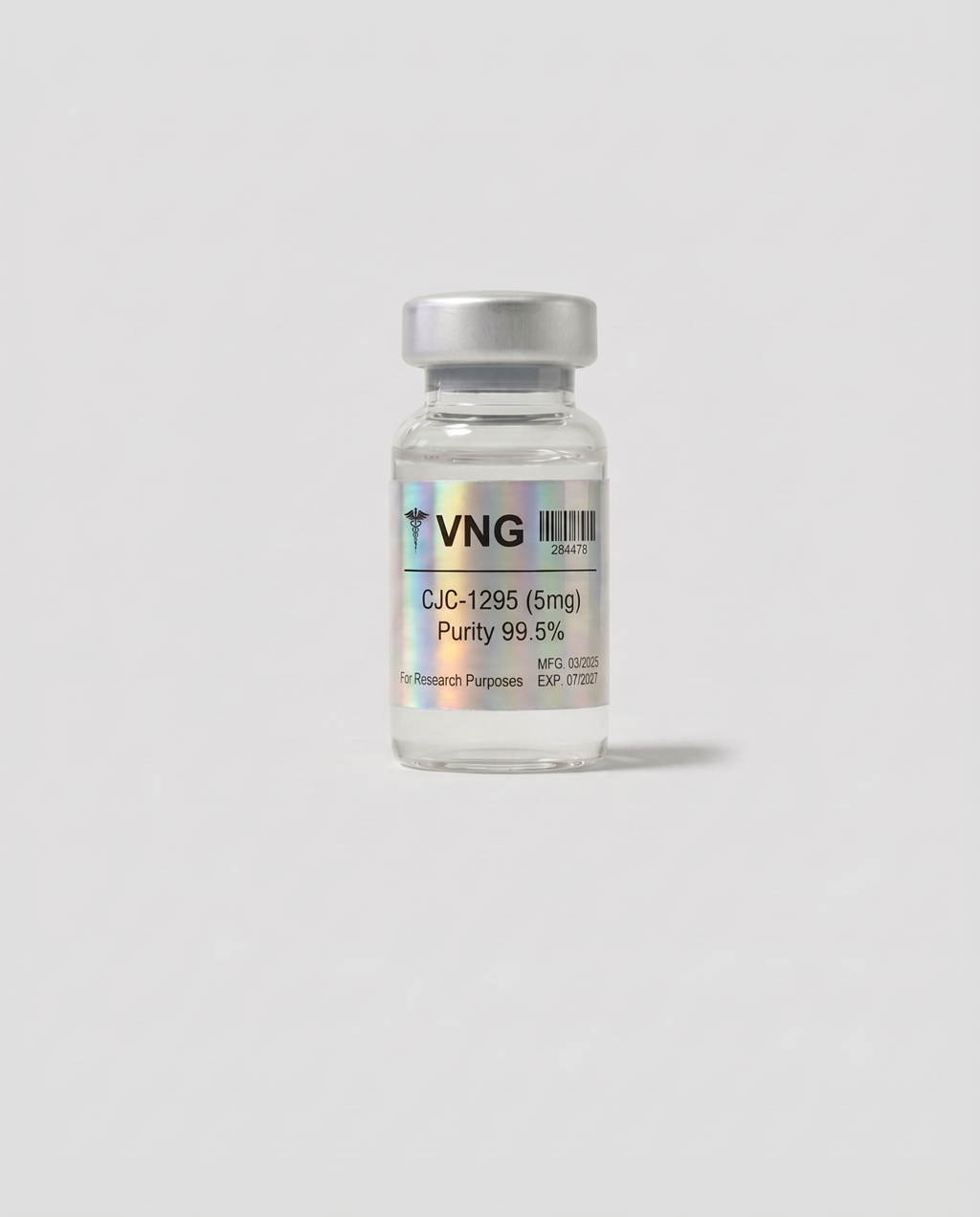
For research & educational purposes only. This article is a neutral, procedural reference for laboratory / in-vitro research handling — not medical advice or a usage recommendation. These materials are not for human or animal consumption.
On this page
What CJC-1295 (No DAC) is
CJC-1295 in its no-DAC form (also called modified GRF 1-29) is a lab-made analog of growth-hormone-releasing hormone, GHRH. It is supplied as an analytical-grade reference material for laboratory research.
Where it comes from
CJC-1295 was created in the early 2000s by the biotech company ConjuChem as part of an effort to make the body's growth-hormone-releasing hormone (GHRH) last far longer than it naturally does. Native GHRH survives only a couple of minutes in the bloodstream. Researchers started from the active 1-29 fragment of GHRH and added stabilizing amino-acid substitutions; a 2005 paper in Endocrinology described attaching this modified fragment to albumin to identify CJC-1295 as a long-lasting analog. The 'no-DAC' version studied here keeps the stabilizing tweaks without the albumin-binding attachment.
What it does — in plain terms
Your brain sends GHRH to the pituitary gland as a 'please make some growth hormone' message. CJC-1295 copies that message, but small structural tweaks make it more stable, so it lasts longer than natural GHRH. In research it's used to study how stimulating the GHRH receptor changes the release of growth hormone and its downstream messenger IGF-1 — and, notably, the studies found the pituitary keeps firing in its natural pulses rather than one flat surge. The no-DAC version is shorter-acting than the albumin-binding 'DAC' version, so labs pick one or the other depending on the experiment.
How it works
Growth hormone starts with a message from the brain: the hypothalamus sends growth-hormone-releasing hormone (GHRH) to the pituitary gland, telling it to release a pulse of growth hormone. CJC-1295 is a lab-made copy of the business end of that message — the first 29 amino acids of GHRH — carrying small substitutions that protect it from the enzymes that normally chew up natural GHRH within minutes. The result is a GHRH-receptor agonist that holds together much longer.
The most-studied version, the one behind the original human data, went a step further: a 'drug affinity complex' (DAC) let the peptide latch onto albumin, a long-lived blood protein, extending its action to days. In healthy adults, that albumin-binding form produced sustained increases in growth hormone and its downstream messenger IGF-1. A striking finding was that the pituitary kept firing in its natural pulses rather than pouring out one continuous flat stream — the rhythm was preserved even under prolonged stimulation.
The 'no-DAC' form supplied here shares the same stabilized GHRH backbone but omits the albumin anchor, so it acts over a shorter window. Researchers choose between the two depending on the experiment — the DAC form for long, steady stimulation, the no-DAC form when a briefer, more pulse-like signal is wanted. Both are tools for asking the same underlying question: what happens downstream when you switch on the GHRH receptor.
What the research shows
The CJC-1295 literature is modest but includes real human data, which is unusual for this corner of peptide research. The core studies are small trials in healthy adults plus animal and biochemistry work, and much of the striking human data — days-long hormone elevation — comes specifically from the albumin-binding 'DAC' form rather than the shorter-acting no-DAC version. These are mechanism-and-pharmacology studies, not large clinical-outcome trials. With that framing, here is what the key work reports.
- The Journal of Clinical Endocrinology & Metabolism, 2006 — reported that CJC-1295, a long-acting GHRH analog, produced prolonged increases in growth hormone and IGF-1 secretion in healthy adults.
- The Journal of Clinical Endocrinology & Metabolism, 2006 — found that growth hormone continued to be secreted in natural pulses even during continuous stimulation by CJC-1295, rather than as one flat, uninterrupted release.
- American Journal of Physiology: Endocrinology and Metabolism, 2006 — showed that once-daily CJC-1295 normalized growth in a mouse engineered to lack its own GHRH, restoring the growth-hormone axis in an animal model.
- Endocrinology, 2005 — described attaching a modified GHRH(1-29) fragment to albumin, identifying CJC-1295 as a long-lasting analog that still activates the GHRH (GRF) receptor.
What CJC-1295 (No DAC) is studied for
GHRH-receptor stimulation. At its core, CJC-1295 is a stabilized copy of GHRH that switches on the same receptor, letting researchers study growth-hormone release with a signal that lasts far longer than the native hormone.
Growth hormone and IGF-1 output. In healthy-adult studies the analog raised both growth hormone and its downstream messenger IGF-1, the readout used to confirm the axis is being driven.
Preserved pulsatility. A notable finding was that the pituitary kept releasing growth hormone in its natural rhythmic pulses even under continuous stimulation — an important detail for understanding how the system self-regulates.
Long-acting analog design. The albumin-binding 'DAC' chemistry was the point of the original work: it showed how a short-lived hormone fragment could be engineered into a days-long analog, with the no-DAC form offering a shorter alternative.
Storage & handling
As a lyophilized powder, CJC-1295 (no-DAC) reference material keeps best cold and dark — refrigerated for short-term storage, frozen for longer holds. After reconstitution with bacteriostatic water it should be refrigerated at roughly 2–8 °C, protected from light, and kept away from repeated freeze-thaw cycles, which degrade peptides. See the reconstitution reference below for the concentration math. Supplied for laboratory research use only.
Plain-language explanations describe what researchers study — not what any product does for a person, and not medical advice. Every material here is sold for laboratory research use only and is not for human or animal use.
Reconstitution reference
Standard laboratory reconstitution volumes for CJC-1295 (No DAC), from the VNG Reconstitution Sheet. See the full reconstitution guide for the method and concentration math.
| Product | Vial | Bacteriostatic water | Resulting concentration |
|---|---|---|---|
| CJC-1295 + Ipamorelin | 5 mg + 5 mg | 2 mL | 5 mg/mL (of the blend) |
Frequently asked questions
What is CJC-1295?
CJC-1295 is a synthetic analog of growth-hormone-releasing hormone (GHRH), built from the hormone's active 1-29 fragment with stabilizing modifications so it lasts longer than natural GHRH. It is supplied here as an analytical-grade reference material for laboratory research use only.
What's the difference between the DAC and no-DAC versions?
The 'DAC' (drug affinity complex) version can bind albumin, a long-lived blood protein, which stretches its action to days. The no-DAC form supplied here keeps the same stabilized GHRH backbone but omits that anchor, so it acts over a shorter window. Researchers pick one or the other depending on the experiment.
Does CJC-1295 replace growth hormone?
No — it works one step upstream. Rather than adding growth hormone directly, it stimulates the GHRH receptor so the pituitary releases its own. A recurring finding in the research is that this preserves the body's natural pulsing rhythm of release.
Is CJC-1295 backed by human studies?
There is some human data, which is notable for this field: small studies in healthy adults reported prolonged growth-hormone and IGF-1 increases. But these are mechanism-and-pharmacology studies, not large clinical-outcome trials, and much of the days-long effect came from the albumin-binding DAC form specifically.
Is this product for human use?
No. It is sold strictly as a reference material for laboratory research use only — not for human or veterinary use, and not as a drug or supplement.
Published research
A selection of peer-reviewed and clinical literature indexed on PubMed. Provided so qualified researchers can locate the primary sources — inclusion here is not a claim about any product or outcome.
- Human studyThe Journal of clinical endocrinology and metabolism · 2006
Prolonged stimulation of growth hormone and IGF-I secretion by CJC-1295, a long-acting GHRH analog, in healthy adults
View on PubMed - Human studyThe Journal of clinical endocrinology and metabolism · 2006
Pulsatile secretion of growth hormone persists during continuous stimulation by CJC-1295
View on PubMed - Animal studyAmerican journal of physiology. Endocrinology and metabolism · 2006
Once-daily CJC-1295, a long-acting GHRH analog, normalizes growth in the GHRH-knockout mouse
View on PubMed - Lab studyEndocrinology · 2005
hGRF(1-29)-albumin bioconjugates activate the GRF receptor: identification of CJC-1295 as a long-lasting analog
View on PubMed
References & resources
Continue reading
- Sermorelin vs Tesamorelin vs CJC-1295: Three GHRH Analogs ComparedAll three act at the same receptor. They differ in fragment length, stability and how much published human data stands behind each.
- Tesamorelin vs CJC-1295 vs Ipamorelin: GHRH Analogs and SecretagoguesTwo of these are GHRH analogs and one is a ghrelin-receptor secretagogue. Which receptor each engages explains why they are studied together rather than as alternatives.
Related reference materials
VNG Research Team
VNG Labs supplies analytical-grade reference materials with lot-matched Certificates of Analysis. Our write-ups are neutral, source-cited references for qualified and independent researchers.
More from LearnResearch use only. Not for human consumption or veterinary use. Sold exclusively to qualified researchers for in vitro and laboratory research. These statements have not been evaluated by the FDA. Not intended to diagnose, treat, cure, or prevent any disease. Refrigerate upon receipt. Keep in dark environment.