
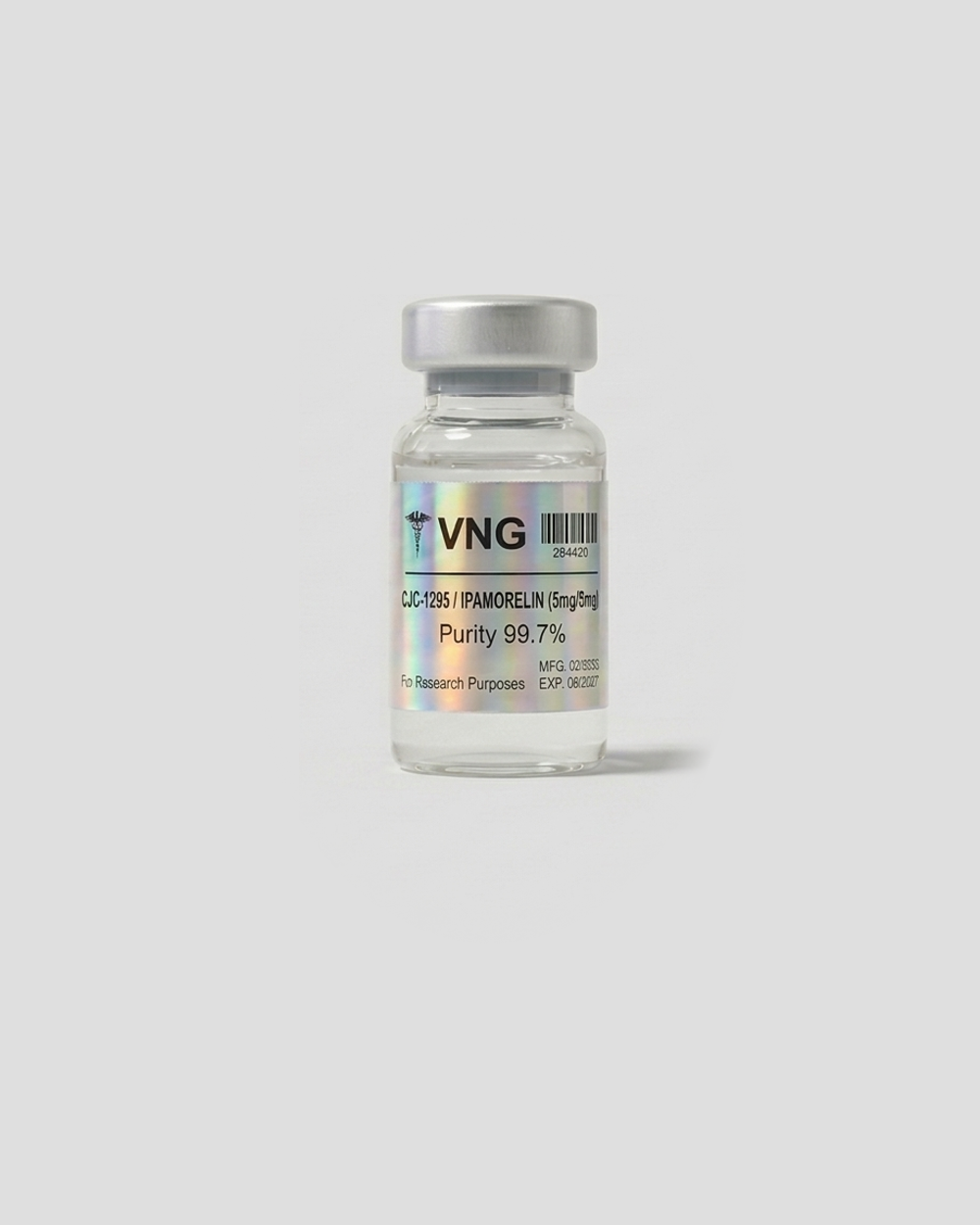
For research & educational purposes only. This article is a neutral, procedural reference for laboratory / in-vitro research handling — not medical advice or a usage recommendation. These materials are not for human or animal consumption.
On this page
What CJC-1295 + Ipamorelin is
This is a two-in-one research blend: CJC-1295 (a copy of the 'release growth hormone' signal, GHRH) plus Ipamorelin (which pushes the same system from a different angle). It is supplied as an analytical-grade reference material for laboratory research.
Where it comes from
This is not a single discovered molecule but a research pairing of two separately developed compounds. CJC-1295 is a long-acting analog of growth-hormone-releasing hormone (GHRH), created in the early 2000s; ipamorelin is a selective growth-hormone secretagogue first described in 1998. Each was designed to switch on growth-hormone release, but through a different receptor. Combining a GHRH-type peptide with a ghrelin-receptor secretagogue is a long-standing experimental design in endocrinology, because the two signals reinforce one another — so the 'blend' reflects that established two-pathway approach rather than a new discovery.
What it does — in plain terms
The body's growth-hormone system has more than one 'go' button. CJC-1295 presses one of them (the GHRH signal); Ipamorelin presses another (the ghrelin/secretagogue signal). Pairing them is a common research design, because pressing two buttons at once is a cleaner way to study how the system responds. Ipamorelin is also of interest because it's 'selective' — it nudges growth hormone without stirring up other hormones as much.
How it works
The body's growth-hormone system has more than one 'go' button, and this blend presses two of them at once. CJC-1295 acts on the GHRH receptor — the pathway the brain normally uses to request a pulse of growth hormone. Ipamorelin acts on a different receptor, the ghrelin/secretagogue receptor (GHS-R1a), which serves as an amplifier of that same release. (For the primary studies behind each one, open its own post.)
Pairing a GHRH analog with a secretagogue is a classic endocrine experiment because the two pathways are complementary: stimulating them together tends to produce a larger, cleaner pulse of growth hormone than either alone, while still working through the body's own pituitary rather than adding growth hormone from outside. Ipamorelin contributes selectivity — the original research emphasized that it releases growth hormone without meaningfully raising cortisol or prolactin — which is part of why it is a favored partner in these pairings.
It is worth being clear about the evidence: the provided literature centers on ipamorelin and on growth-hormone secretagogues as a class, rather than on this specific two-peptide combination. So the blend is best understood as a way to study the two release pathways side by side, with the strongest primary data sitting in each component's own record.
What the research shows
Most of the published work here is about ipamorelin specifically, or about growth-hormone secretagogues in general — not head-to-head trials of the CJC-1295-plus-ipamorelin combination itself, and much of it is preclinical (animal and cell studies) with a couple of early human pharmacokinetic reports. Read this as background on the two pathways rather than proof of the blend, and see each component's post for its primary studies. With that context, here is what the provided work reports.
- Physiology & Behavior, 2024 — examined whether ipamorelin could counter body-weight decline and appetite loss in an animal model of chemotherapy-associated wasting (cachexia).
- European Journal of Endocrinology, 1998 — characterized ipamorelin as the first selective growth-hormone secretagogue, releasing growth hormone in animal models without meaningfully raising cortisol or prolactin.
- JAAOS Global Research & Reviews, 2026 — reviewed therapeutic peptides in orthopaedics, placing growth-hormone secretagogues such as ipamorelin within the broader landscape of research peptides.
- Growth Hormone & IGF Research, 1999 — found that ipamorelin induced longitudinal bone growth in rats, a downstream marker of growth-hormone activity.
- Pharmaceutical Research, 1999 — modeled the pharmacokinetics of ipamorelin in human volunteers, describing how the peptide is cleared and how growth-hormone release tracks it.
- Xenobiotica, 1998 — evaluated the pharmacokinetics of ipamorelin and related secretagogues, with emphasis on nasal absorption as a delivery route.
- Bioorganic & Medicinal Chemistry Letters, 2001 — reported chemistry work on growth-hormone-secretagogue hybrids built from ipamorelin, exploring how structure shapes activity.
- Translational Andrology and Urology, 2020 — reviewed growth-hormone secretagogues and their studied effects on body composition.
- Histology and Histopathology, 2002 — examined how prolonged administration of ipamorelin affected the pituitary's growth-hormone-producing (somatotroph) cells in young rats, studied in vitro.
- Growth Hormone & IGF Research, 2001 — studied whether ipamorelin could offset steroid-induced bone loss in rats, another readout of growth-hormone and IGF-1 activity.
What CJC-1295 + Ipamorelin is studied for
Two release pathways together. The whole point of the pairing: CJC-1295 drives the GHRH receptor while ipamorelin drives the ghrelin/secretagogue receptor, letting researchers study how the two complementary signals combine to release growth hormone.
Selective secretagogue signaling. Ipamorelin's contribution is selectivity — foundational research described it releasing growth hormone without meaningfully raising cortisol or prolactin, which makes the combined signal cleaner to interpret.
Downstream growth-hormone effects. Component studies in animals tracked classic readouts of growth-hormone activity, such as longitudinal bone growth and steroid-related bone loss, to confirm the axis is being switched on.
Pharmacokinetics of the components. Early human and animal studies mapped how ipamorelin is cleared and absorbed, groundwork for understanding how a secretagogue behaves before it is paired with a GHRH analog.
Storage & handling
As a lyophilized powder, this CJC-1295-plus-ipamorelin blend keeps best cold and dark — refrigerated for the near term, frozen for longer storage. Once reconstituted with bacteriostatic water it should be held at roughly 2–8 °C, protected from light, and shielded from repeated freeze-thaw cycles, which degrade peptides. Because it contains two peptides, handle it gently and use it promptly after reconstitution; see the reconstitution reference below for the concentration math. For laboratory research use only.
Plain-language explanations describe what researchers study — not what any product does for a person, and not medical advice. Every material here is sold for laboratory research use only and is not for human or animal use.
Reconstitution reference
Standard laboratory reconstitution volumes for CJC-1295 + Ipamorelin, from the VNG Reconstitution Sheet. See the full reconstitution guide for the method and concentration math.
| Product | Vial | Bacteriostatic water | Resulting concentration |
|---|---|---|---|
| CJC-1295 + Ipamorelin | 5 mg + 5 mg | 2 mL | 5 mg/mL (of the blend) |
Frequently asked questions
What is the CJC-1295 + Ipamorelin blend?
The CJC-1295 + Ipamorelin blend is a two-in-one research blend combining CJC-1295, a long-acting GHRH analog, with ipamorelin, a selective growth-hormone secretagogue. The two act on different receptors of the same growth-hormone system. It is supplied as an analytical-grade reference material for laboratory research use only.
Why are these two peptides combined?
CJC-1295 and ipamorelin press different 'go' buttons on the growth-hormone system — CJC-1295 the GHRH receptor, ipamorelin the ghrelin receptor. Stimulating both pathways at once is a long-standing experimental design because the signals are complementary, which is a cleaner way to study how the system responds.
Is the combination itself backed by clinical trials?
Not directly. The available literature centers on ipamorelin and on growth-hormone secretagogues as a class — much of it preclinical — rather than head-to-head trials of this specific blend. It is best understood as a tool for studying the two pathways together, with the primary evidence sitting in each component's own record.
Where can I read the studies behind each ingredient?
Open the individual CJC-1295 and ipamorelin posts. Each has its own discovery, mechanism, and study-note section drawn from the primary literature for that compound.
Is this product for human use?
No. It is sold strictly as a reference material for laboratory research use only — not for human or veterinary use, and not as a drug or supplement.
Published research
A selection of peer-reviewed and clinical literature indexed on PubMed. Provided so qualified researchers can locate the primary sources — inclusion here is not a claim about any product or outcome.
- Animal-model studyPhysiology & behavior · 2024
Ipamorelin and chemotherapy weight loss — animal study
View on PubMed - Peer-reviewed studyEuropean journal of endocrinology · 1998
Ipamorelin — first selective GH secretagogue
View on PubMed - Peer-reviewed reviewJournal of the American Academy of Orthopaedic Surgeons. Global research & reviews · 2026
Therapeutic peptides in orthopaedics — review
View on PubMed - Animal-model studyGrowth hormone & IGF research : official journal of the Growth Hormone Research Society and the International IGF Research Society · 1999
Ipamorelin and bone growth — rats
View on PubMed - Human clinical studyPharmaceutical research · 1999
Ipamorelin pharmacokinetics in human volunteers
View on PubMed - Peer-reviewed studyXenobiotica; the fate of foreign compounds in biological systems · 1998
Ipamorelin pharmacokinetics & nasal absorption
View on PubMed - Peer-reviewed studyBioorganic & medicinal chemistry letters · 2001
GH secretagogue hybrids of ipamorelin — chemistry
View on PubMed - Peer-reviewed studyTranslational andrology and urology · 2020
GH secretagogues and body composition — review
View on PubMed - Animal-model studyHistology and histopathology · 2002
Ipamorelin and somatotroph response — rats
View on PubMed - Animal-model studyGrowth hormone & IGF research : official journal of the Growth Hormone Research Society and the International IGF Research Society · 2001
Ipamorelin and steroid-related bone loss — rats
View on PubMed
References & resources
Continue reading
Related reference materials
VNG Research Team
VNG Labs supplies analytical-grade reference materials with lot-matched Certificates of Analysis. Our write-ups are neutral, source-cited references for qualified and independent researchers.
More from LearnResearch use only. Not for human consumption or veterinary use. Sold exclusively to qualified researchers for in vitro and laboratory research. These statements have not been evaluated by the FDA. Not intended to diagnose, treat, cure, or prevent any disease. Refrigerate upon receipt. Keep in dark environment.