
For research & educational purposes only. This article is a neutral, procedural reference for laboratory / in-vitro research handling — not medical advice or a usage recommendation. These materials are not for human or animal consumption.
On this page
What DSIP is
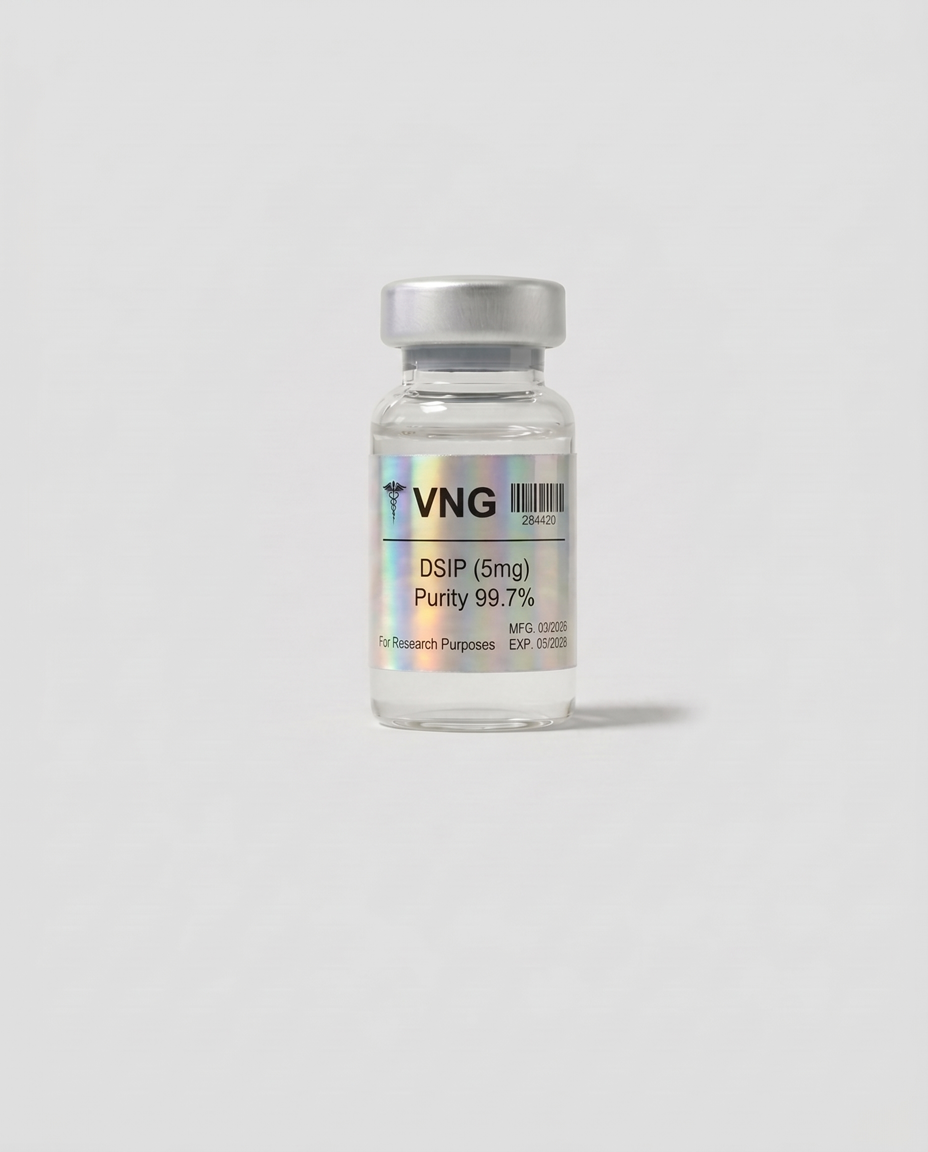
DSIP (delta sleep-inducing peptide) is a nonapeptide, nine amino acids long, isolated in 1977 from the cerebral venous blood of rabbits during induced sleep. It is supplied as an analytical-grade reference material for laboratory research.
Where it comes from
Schoenenberger and Monnier isolated DSIP in 1977 by cross-circulating blood between rabbits: when one animal was put into delta sleep by stimulating its thalamus, a factor in its cerebral venous blood produced delta activity in a recipient. The nine-residue sequence (Trp-Ala-Gly-Gly-Asp-Ala-Ser-Gly-Glu) was determined and synthesised, and for a decade the peptide was studied intensely. No receptor was ever pinned down, and by 2006 a Journal of Neurochemistry review could still call it an unresolved riddle.
What it does — in plain terms
The name promises more than the literature delivers. Early work reported that DSIP nudged animals toward slow-wave (delta) sleep, and a small 1987 trial reported better sleep measures in chronic insomniacs. Later reviews found the sleep effect inconsistent and turned to other observations: stress responses, pain thresholds, circadian rhythms, and recovery in stroke models.
How it works
Nobody has identified a DSIP receptor, and the peptide is broken down quickly in blood, so how it acts is inferred rather than known. Proposed routes include effects on GABA and glutamate signalling, on opioid and monoamine systems, and on the hypothalamic-pituitary axis.
Some of the more reproducible observations concern stress rather than sleep: in animal work DSIP and related preparations blunted stress-induced changes in behaviour and hormones. A 2009 review in Obesity Reviews even proposed a link to circadian mechanisms via the glucocorticoid-induced leucine zipper.
A practical complication for researchers is that the native peptide is unstable; phosphorylated and other modified forms were made to survive longer, and some of the animal results were obtained with those analogues rather than DSIP itself.
What the research shows
DSIP has one of the longest and least settled research histories of any peptide in this catalog. There is real published work, including a controlled clinical trial, but the sleep-inducing effect that gave it its name has not held up consistently, most of the evidence is old and small, and modern studies are animal models. Anyone working with it should read the 2006 critical review before the earlier enthusiasm.
- Neuroscience and Biobehavioral Reviews, 1984 — summarised the first years of DSIP research: the isolation from sleeping rabbits, the synthetic peptide, and the mixed picture already emerging on its sleep effects.
- Journal of Neurochemistry, 2006 — reviewed three decades of work and concluded the peptide remained an unresolved riddle: no receptor, inconsistent sleep data, and a range of other reported effects that did not fit one mechanism.
- International Journal of Clinical Pharmacology Research, 1987 — a small controlled trial reported improved sleep measures in chronic insomniacs after short-term administration; the trial is old and small and has not been replicated at scale.
- Neuroscience and Behavioral Physiology, 2008 — compared DSIP with the related preparation Deltaran in animal models of stress, reporting protective effects on stress-related behaviour and physiology.
- Molecules, 2021 — reported that DSIP improved recovery of motor function in rats after an experimentally induced focal stroke.
What DSIP is studied for
Slow-wave sleep. The original observation and the source of the name. Results across species and studies were inconsistent, which is the central problem later reviews wrestle with.
Stress responses. A more reproducible line of animal work in which DSIP or its analogues reduced stress-induced behavioural and hormonal changes.
Circadian and endocrine rhythms. DSIP levels vary with time of day, and several studies examined its interaction with cortisol, growth hormone and other rhythmic hormones.
Brain-injury models. Recent rodent studies looked at recovery after stroke and at sleep and memory under high-altitude hypoxia, using the native or a phosphorylated peptide.
Storage & handling
As a lyophilized (freeze-dried) powder, DSIP reference material is most stable kept cold and dark, refrigerated or frozen for longer holds. The native peptide is short-lived in solution: reconstitute with bacteriostatic water, refrigerate at roughly 2-8 °C, keep out of light, and avoid repeated freeze-thaw cycles.
Plain-language explanations describe what researchers study — not what any product does for a person, and not medical advice. Every material here is sold for laboratory research use only and is not for human or animal use.
Frequently asked questions
What is DSIP?
Delta sleep-inducing peptide is a nine-amino-acid peptide isolated in 1977 from the cerebral venous blood of rabbits in induced sleep. It is supplied here as an analytical-grade reference material for laboratory research use only.
Does DSIP actually induce sleep?
The published record is inconsistent. Early animal work and one small 1987 trial reported effects on sleep; later reviews, including a 2006 critical review, found the sleep effect unreliable and no receptor has been identified.
What else has DSIP been studied for?
Stress-response modulation, circadian and endocrine rhythms, pain thresholds, and recovery in rodent models of stroke and high-altitude hypoxia. Most of this is animal work.
Why is DSIP called an unresolved riddle?
Because after decades of study there is still no receptor, no agreed mechanism, and a body of results that do not fit together; that phrase is the title of the 2006 Journal of Neurochemistry review.
How is DSIP stored and reconstituted?
Keep the lyophilized powder cold and dark; reconstitute with bacteriostatic water, refrigerate at about 2-8 °C, and use promptly, since the native peptide degrades quickly in solution.
Published research
A selection of peer-reviewed and clinical literature indexed on PubMed. Provided so qualified researchers can locate the primary sources — inclusion here is not a claim about any product or outcome.
- Foundational reviewNeuroscience and Biobehavioral Reviews · 1984
Delta-sleep-inducing peptide (DSIP): a review
View on PubMed - Critical reviewJournal of Neurochemistry · 2006
Delta sleep-inducing peptide (DSIP): a still unresolved riddle
View on PubMed - Controlled clinical trialInternational Journal of Clinical Pharmacology Research · 1987
Study of delta sleep-inducing peptide efficacy in improving sleep on short-term administration to chronic insomniacs
View on PubMed - Animal studyNeuroscience and Behavioral Physiology · 2008
Delta sleep-inducing peptide and Deltaran: potential approaches to antistress protection
View on PubMed - Animal-model studyMolecules · 2021
Delta Sleep-Inducing Peptide Recovers Motor Function in SD Rats after Focal Stroke
View on PubMed
References & resources
Related reference materials
VNG Research Team
VNG Labs supplies analytical-grade reference materials with lot-matched Certificates of Analysis. Our write-ups are neutral, source-cited references for qualified and independent researchers.
More from LearnResearch use only. Not for human consumption or veterinary use. Sold exclusively to qualified researchers for in vitro and laboratory research. These statements have not been evaluated by the FDA. Not intended to diagnose, treat, cure, or prevent any disease. Refrigerate upon receipt. Keep in dark environment.