
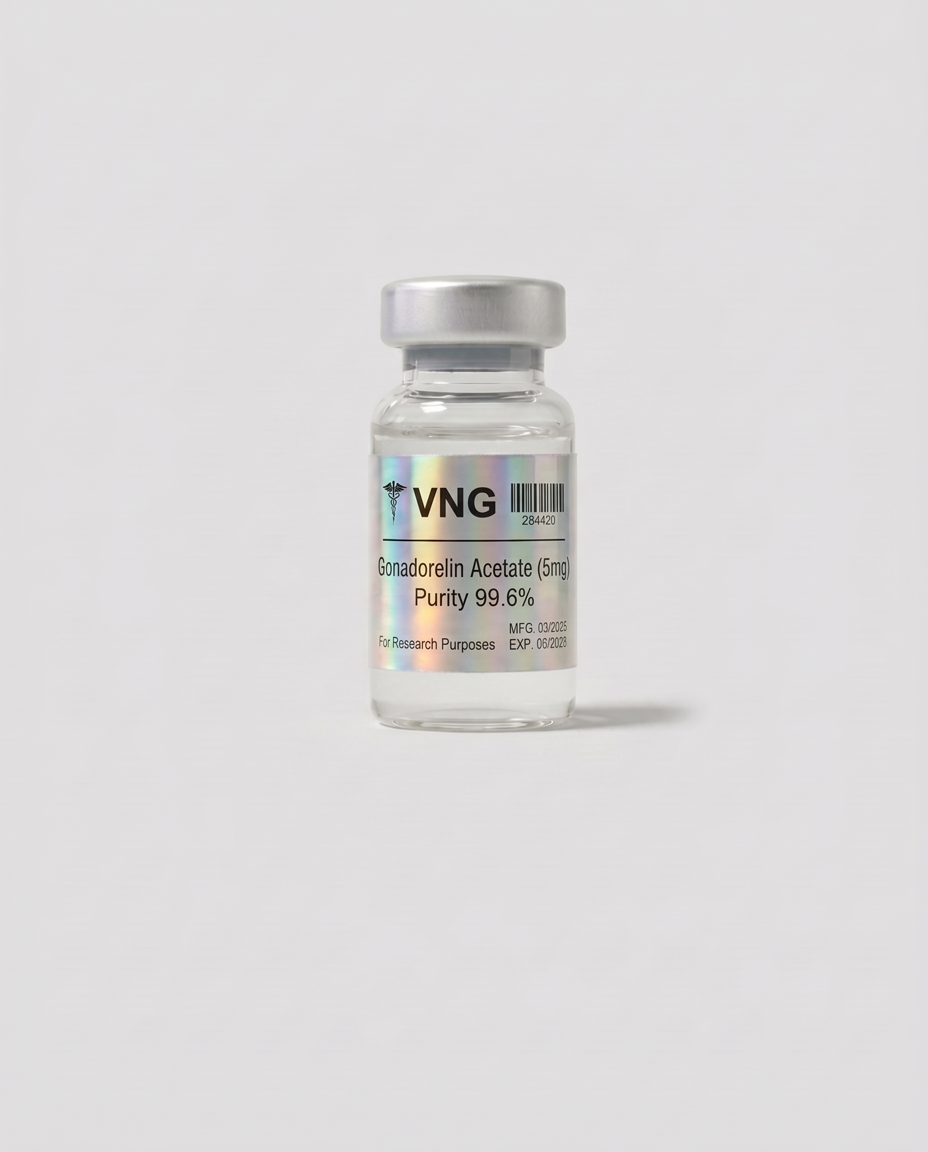
For research & educational purposes only. This article is a neutral, procedural reference for laboratory / in-vitro research handling — not medical advice or a usage recommendation. These materials are not for human or animal consumption.
On this page
What Gonadorelin Acetate is
Gonadorelin is the synthetic form of gonadotropin-releasing hormone (GnRH, also called LHRH), a decapeptide made in the hypothalamus. It is supplied as gonadorelin acetate, an analytical-grade reference material for laboratory research.
Where it comes from
The hypothalamic releasing factor for LH was isolated and sequenced in 1971 by the groups of Andrew Schally and Roger Guillemin, work that shared the 1977 Nobel Prize in Physiology or Medicine. The peptide, pGlu-His-Trp-Ser-Tyr-Gly-Leu-Arg-Pro-Gly-NH2, was synthesised soon after as gonadorelin and became both a diagnostic agent and the template for every later GnRH agonist and antagonist.
What it does — in plain terms
GnRH is the top of the reproductive hormone chain. Released in pulses, it acts on the pituitary to trigger luteinizing hormone (LH) and follicle-stimulating hormone (FSH), which in turn drive the testes and ovaries. In research, gonadorelin is the reference tool for probing that axis: a single dose provokes an LH surge, while continuous exposure does the opposite and switches the receptors off.
How it works
Gonadorelin binds the GnRH receptor on pituitary gonadotroph cells. A brief pulse causes those cells to release LH and, to a lesser degree, FSH into the blood; the natural hypothalamus does exactly this roughly every 60 to 120 minutes.
Timing is everything. Continuous exposure to a GnRH agonist desensitises and down-regulates the receptor, so LH and FSH fall instead of rising. That paradox is the basis of the long-acting agonists used clinically, and it is why research protocols with gonadorelin are usually pulsatile or single-dose.
The native peptide is cleared within minutes, which suits stimulation testing and pulsatile pump studies but makes it a poor tool for sustained receptor activation; the longer-acting analogues (leuprolide, buserelin, nafarelin) were designed to fix that.
What the research shows
Gonadorelin is one of the best-characterised peptides in endocrinology, but its literature is largely clinical-diagnostic and veterinary rather than the kind of mechanistic peptide research seen elsewhere in this catalog. Human data on pulsatile gonadorelin for hypogonadotropic hypogonadism come mostly from small case series, and much of the recent work is in cattle, goats and cats.
- The Medical Letter, 1983 — profiled gonadorelin as synthetic LH-RH at the point it entered use as a pituitary stimulation test, describing the expected LH and FSH response.
- American Family Physician, 1991 — reviewed the GnRH agonists gonadorelin, leuprolide and nafarelin, explaining why pulsatile dosing stimulates and continuous dosing suppresses gonadotropin release.
- Drug Development and Industrial Pharmacy, 1999 — validated a biological assay in which gonadorelin-induced LH release, read out as testosterone, served as a potency test for gonadorelin preparations.
- Journal of Peking University (Health Sciences), 2014 — reported cases of pituitary stalk interruption syndrome in which pulsatile micropump gonadorelin restored gonadotropin output, alongside a literature review.
- Theriogenology, 2015 — compared gonadorelin with lecirelin and buserelin in cattle, measuring the LH surge, ovulation timing and progesterone.
What Gonadorelin Acetate is studied for
Pituitary stimulation testing. A single dose followed by timed LH and FSH measurements shows whether the pituitary can respond, the original diagnostic use.
Pulsatile versus continuous signalling. The same peptide stimulates or suppresses depending on rhythm; research with micropumps mimics the natural pulse to keep the axis running.
Hypogonadotropic hypogonadism. Case series describe pulsatile gonadorelin restoring gonadotropin output when the hypothalamic signal is missing; the evidence base is small.
Animal reproduction. Veterinary studies use gonadorelin to time ovulation in cattle and other species, and these provide much of the recent controlled data on dose and response.
Storage & handling
As a lyophilized (freeze-dried) powder, gonadorelin acetate reference material is most stable kept cold and dark, refrigerated or frozen for longer holds. Once reconstituted with bacteriostatic water it should be refrigerated at roughly 2-8 °C and protected from light and repeated freeze-thaw cycles; the peptide is short-lived in solution.
Plain-language explanations describe what researchers study — not what any product does for a person, and not medical advice. Every material here is sold for laboratory research use only and is not for human or animal use.
Frequently asked questions
What is gonadorelin?
Gonadorelin is synthetic gonadotropin-releasing hormone (GnRH), a ten-amino-acid hypothalamic peptide, supplied as the acetate salt. It is an analytical-grade reference material for laboratory research use only.
How does gonadorelin work in research?
It binds GnRH receptors on the pituitary. A pulse triggers LH and FSH release; continuous exposure desensitises the receptor and suppresses them, so dosing rhythm decides the effect.
What has gonadorelin been studied for?
Pituitary stimulation testing, pulsatile therapy research in hypogonadotropic hypogonadism (small case series), and reproductive timing in animal studies.
How is gonadorelin different from leuprolide?
Leuprolide is a modified, long-acting GnRH agonist designed to suppress the axis through continuous receptor activation. Gonadorelin is the native sequence with a half-life of minutes.
How is gonadorelin stored and reconstituted?
Keep the lyophilized powder cold and dark; reconstitute with bacteriostatic water, refrigerate at about 2-8 °C, and avoid repeated freeze-thaw cycles.
Published research
A selection of peer-reviewed and clinical literature indexed on PubMed. Provided so qualified researchers can locate the primary sources — inclusion here is not a claim about any product or outcome.
- ProfileThe Medical Letter on Drugs and Therapeutics · 1983
Gonadorelin, synthetic LH-RH
View on PubMed - ReviewAmerican Family Physician · 1991
GnRH agonists: gonadorelin, leuprolide and nafarelin
View on PubMed - Bioassay studyDrug Development and Industrial Pharmacy · 1999
Gonadorelin-induced testosterone release: a biological assay for quality assurance of gonadorelin in veterinary medicine
View on PubMed - Case series and reviewJournal of Peking University (Health Sciences) · 2014
Micropump infusion of gonadorelin in the treatment of hypogonadotropic hypogonadism in patients with pituitary stalk interruption syndrome: cases analysis and literature review
View on PubMed - Comparative animal studyTheriogenology · 2015
Effect of gonadorelin, lecirelin, and buserelin on LH surge, ovulation, and progesterone in cattle
View on PubMed
References & resources
Related reference materials
VNG Research Team
VNG Labs supplies analytical-grade reference materials with lot-matched Certificates of Analysis. Our write-ups are neutral, source-cited references for qualified and independent researchers.
More from LearnResearch use only. Not for human consumption or veterinary use. Sold exclusively to qualified researchers for in vitro and laboratory research. These statements have not been evaluated by the FDA. Not intended to diagnose, treat, cure, or prevent any disease. Refrigerate upon receipt. Keep in dark environment.