
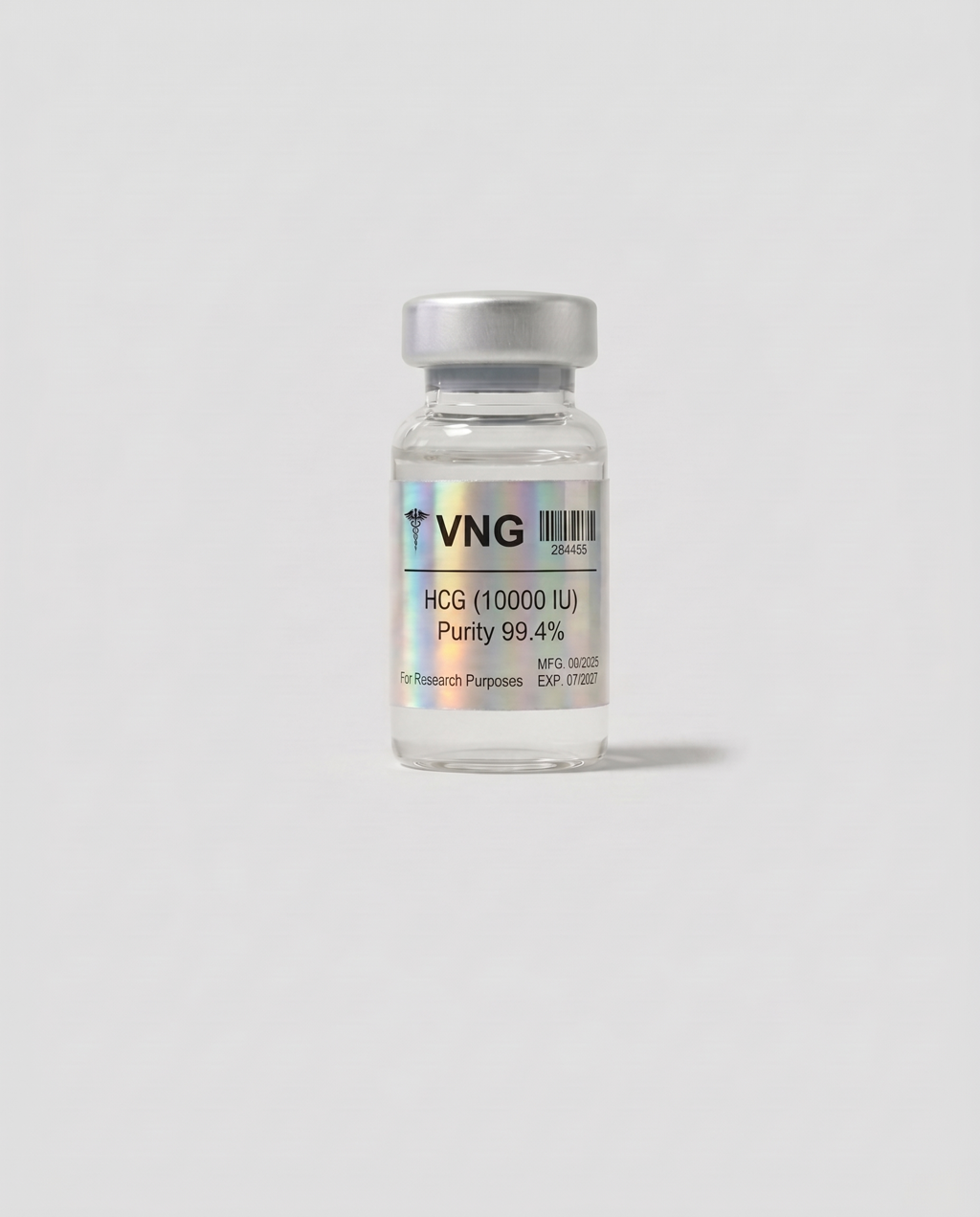
For research & educational purposes only. This article is a neutral, procedural reference for laboratory / in-vitro research handling — not medical advice or a usage recommendation. These materials are not for human or animal consumption.
On this page
What HCG is
HCG (human chorionic gonadotropin) is a natural glycoprotein hormone, produced in large amounts during pregnancy. It is supplied as an analytical-grade reference material for laboratory research only.
Where it comes from
HCG — human chorionic gonadotropin — is the hormone the placenta begins pouring out within days of an embryo implanting, and it is the signal that home and clinical pregnancy tests are built to detect. Chemically it is a two-part glycoprotein: an alpha subunit it shares with the pituitary hormones LH, FSH, and TSH, and a distinctive beta subunit that gives it its identity. That beta chain makes hCG so structurally close to luteinizing hormone that it engages the very same receptor — which is exactly why endocrinologists reached for it, decades ago, as a tool to probe the gonads.
What it does — in plain terms
HCG is shaped so much like the body's own luteinizing hormone (LH) that it fits the very same receptor on the cells of the gonads. When it docks onto that LH/hCG receptor, it switches on the machinery those cells use to make sex steroids — testosterone in the testes' Leydig cells, progesterone in the ovary. Because it presses that one well-defined button so reliably, researchers have used it for decades as a standard way to study how the gonads respond to hormonal signals and how steroid production is switched on.
How it works
HCG works by imitation. Its shape lets it dock onto the LH/hCG receptor — a receptor that normally waits for luteinizing hormone — on the steroid-making cells of the gonads: the Leydig cells of the testis and the theca and luteal cells of the ovary. Once hCG binds, the receptor triggers the internal cascade (rising cyclic AMP and the enzymes that shuttle cholesterol toward steroid synthesis) that turns raw cholesterol into sex steroids — testosterone on the male side, progesterone on the female side.
Two features make it a favorite laboratory probe rather than just a copy of LH. First, hCG is heavily sugar-coated (glycosylated), which slows its breakdown and gives a longer, steadier stimulus than the short pulses of natural LH. Second, it presses that single LH/hCG receptor so reliably that researchers can use a fixed dose of hCG as a clean, repeatable 'on' switch for the gonad and then measure exactly how the tissue answers.
The response is not limited to the headline steroids. Work in isolated Leydig cells has shown that hCG can also acutely switch on aromatase — the enzyme that converts androgens into estrogens — so the same signal that drives testosterone output also feeds the local balance between androgen and estrogen. That mix of effects is part of why the hCG-stimulated Leydig cell became such a well-worn model system in reproductive endocrinology.
What the research shows
Because hCG has been a working endocrine tool for so long, a good deal of its literature is primary cell work and human physiology rather than only animal modeling — but much of the foundational material is older and narrowly focused on how the gonad's steroid machinery responds to the signal. With that in mind, here is what several of the key published papers actually report.
- The Journal of Clinical Endocrinology & Metabolism, 1987 — described a method for isolating human Leydig cells that responded strongly to hCG, giving researchers a reliable cell model for studying testosterone production.
- Proceedings of the National Academy of Sciences, 1979 — showed that hCG could acutely switch on aromatase in isolated Leydig cells, increasing the conversion of androgens to estrogen in vitro.
- Hormone Research, 2000 — compared how chemically modified derivatives of hCG affected Leydig-cell function, helping map which parts of the hormone drive its signal.
- Israel Journal of Medical Sciences, 1976 — measured the testosterone response to hCG stimulation across pubertal development in humans, using it as a test of Leydig-cell capacity.
What HCG is studied for
Leydig-cell testosterone output. The best-worn use is as a stand-in for LH: a dose of hCG prompts the testis's Leydig cells to make testosterone, so researchers read the response as a readout of how well those cells are working.
The LH/hCG receptor and steroid synthesis. Because hCG activates the same receptor as luteinizing hormone, it is a standard tool for dissecting how that receptor switches on the cholesterol-to-steroid pathway.
Ovulation and corpus-luteum signaling. On the female side the same receptor sits on ovarian cells, and hCG has long been used experimentally to model the LH surge that triggers ovulation and to sustain progesterone from the corpus luteum.
Aromatization and the androgen-estrogen balance. Cell studies show hCG can also switch on aromatase inside Leydig cells, making it useful for studying how a single signal shapes the local balance between androgens and estrogens.
Storage & handling
Supplied as a lyophilized (freeze-dried) powder, hCG reference material keeps best cold and out of the light — refrigerated for short holds, or frozen for longer storage. As a glycoprotein it is sensitive to heat and to repeated freezing and thawing, so once it is reconstituted with bacteriostatic water it should be kept refrigerated at roughly 2-8 °C, shielded from light, and used without repeated freeze-thaw cycles. See the reconstitution reference below for the concentration math.
Plain-language explanations describe what researchers study — not what any product does for a person, and not medical advice. Every material here is sold for laboratory research use only and is not for human or animal use.
Frequently asked questions
What is HCG?
HCG (human chorionic gonadotropin) is a natural glycoprotein hormone produced in large amounts by the placenta during pregnancy. It is structurally close to luteinizing hormone and acts on the same receptor in the gonads. It is supplied here as an analytical-grade reference material for laboratory research use only.
Why do researchers compare hCG to luteinizing hormone (LH)?
Because hCG and LH share almost the same receptor. hCG's shape lets it bind and activate the LH/hCG receptor on gonadal cells, and because it is longer-lasting than LH it provides a steadier, more convenient stimulus — which is why it has been used for decades as a laboratory stand-in for LH.
Is HCG studied in humans?
In part, yes. Some of hCG's research base uses primary human cells and human physiology work, such as measuring the testosterone response to hCG during puberty, reflecting its long history as an endocrine tool. None of that is medical guidance, and this material is for laboratory research use only.
What does hCG do to testosterone in research models?
In testicular Leydig cells, hCG binds the LH/hCG receptor and switches on the steroid-making pathway, prompting the cells to produce testosterone. Researchers use that response as a readout of Leydig-cell function rather than as any kind of therapy.
Is HCG a peptide?
Not in the strict sense. hCG is a larger, two-subunit glycoprotein hormone rather than a short peptide, but it is grouped with the research peptides here because of its shared role in hormone-signaling research. It remains a reference material for laboratory use only.
Published research
A selection of peer-reviewed and clinical literature indexed on PubMed. Provided so qualified researchers can locate the primary sources — inclusion here is not a claim about any product or outcome.
- Lab studyThe Journal of clinical endocrinology and metabolism · 1987
Isolation of human Leydig cells highly responsive to human chorionic gonadotropin
View on PubMed - Lab studyProceedings of the National Academy of Sciences of the USA · 1979
Acute stimulation of aromatization in Leydig cells by human chorionic gonadotropin in vitro
View on PubMed - Peer-reviewed studyHormone research · 2000
Effect of human chorionic gonadotropin derivatives on Leydig-cell function
View on PubMed - Human studyIsrael journal of medical sciences · 1976
Human chorionic gonadotropin stimulation of Leydig-cell function in puberty — testosterone response
View on PubMed
References & resources
Related reference materials
VNG Research Team
VNG Labs supplies analytical-grade reference materials with lot-matched Certificates of Analysis. Our write-ups are neutral, source-cited references for qualified and independent researchers.
More from LearnResearch use only. Not for human consumption or veterinary use. Sold exclusively to qualified researchers for in vitro and laboratory research. These statements have not been evaluated by the FDA. Not intended to diagnose, treat, cure, or prevent any disease. Refrigerate upon receipt. Keep in dark environment.