
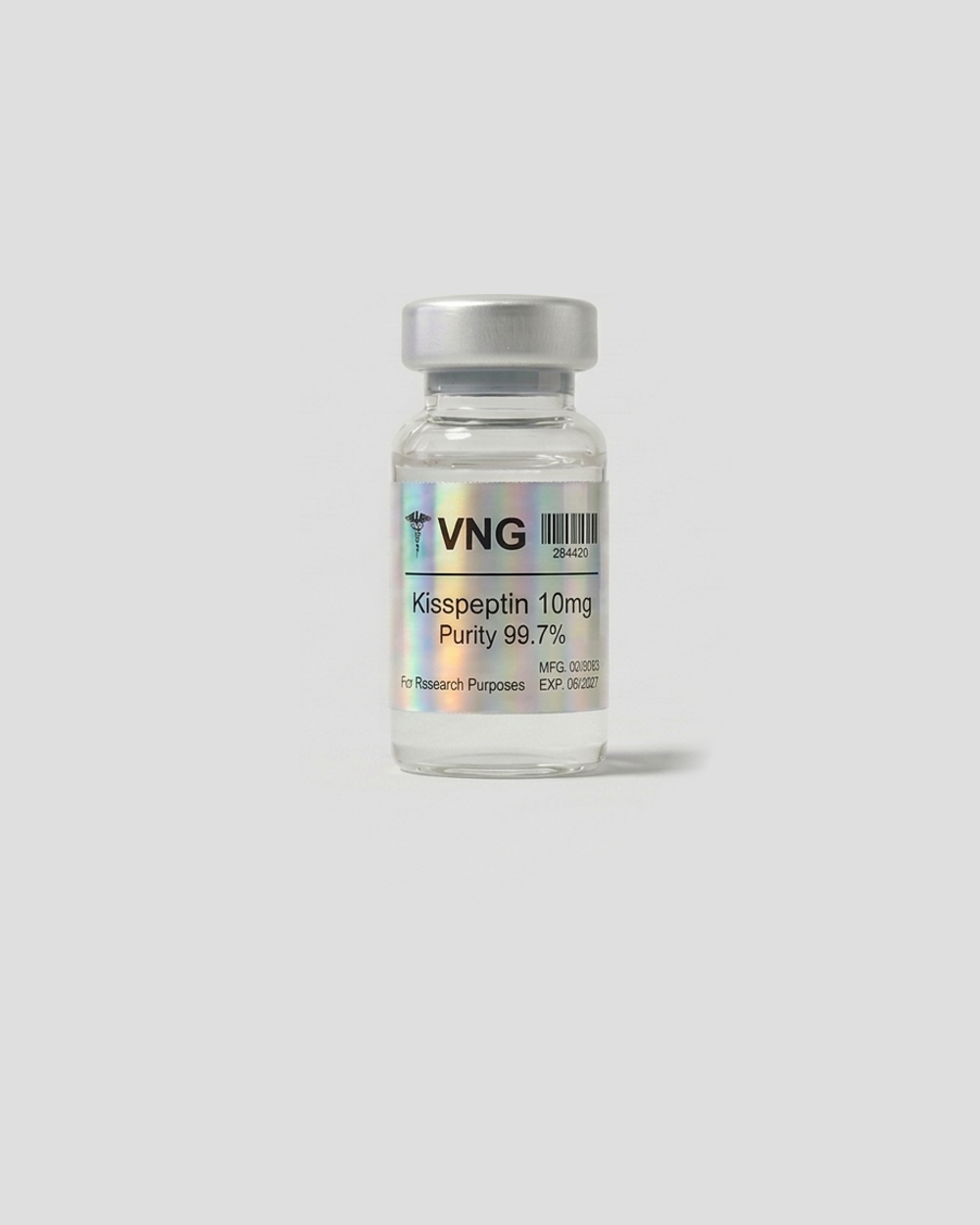
For research & educational purposes only. This article is a neutral, procedural reference for laboratory / in-vitro research handling — not medical advice or a usage recommendation. These materials are not for human or animal consumption.
On this page
What Kisspeptin-10 is
Kisspeptin-10 is a 10-amino-acid piece of a signaling peptide that sits near the very top of the body's reproductive-hormone chain. It is supplied as an analytical-grade reference material for laboratory research.
Where it comes from
Kisspeptin has an unusual origin story. Its parent gene, KISS1, was first identified in the 1990s not in reproduction research at all but as a suppressor of cancer metastasis — and it was named for the Hershey's chocolate Kisses made in the town where it was found. Its true role emerged only when researchers discovered that people and mice lacking a working kisspeptin receptor failed to enter puberty. Kisspeptin-10 is the shortest active tail-end fragment of that protein — ten amino acids that still switch the receptor on — which is why it is the form most often used at the bench.
What it does — in plain terms
Kisspeptin is essentially the 'start' button for the reproductive-hormone system — it tells the brain to begin the cascade of signals that drives puberty and fertility. Researchers study kisspeptin-10 to understand how that switch works: what turns the reproductive hormones on, and how the brain and hormones communicate with each other.
How it works
Kisspeptin sits almost at the top of the reproductive chain of command, the hypothalamic-pituitary-gonadal (HPG) axis. It is released by specialized neurons in the hypothalamus and binds its receptor, KISS1R (also called GPR54), on the GnRH neurons — the cells that hold the master 'go' signal for reproduction. When kisspeptin activates that receptor, the GnRH neurons fire and release GnRH, which tells the pituitary to put out LH and FSH, which in turn drive the ovaries and testes. In short, kisspeptin is the upstream switch that sets the whole cascade in motion.
What makes the system more than a simple relay is that these kisspeptin neurons also act as an integration point. A cluster of them behaves like a pulse generator, setting the rhythmic beat of GnRH release, and they listen to incoming signals about the body's state — including energy and metabolic cues — which is one reason reproduction is so tightly linked to nutrition and body condition. Reviewers describe kisspeptin as the node where information about energy balance is passed on to the reproductive axis.
Kisspeptin-10 is the ten-amino-acid fragment researchers most often use to interrogate this circuitry. It is the short C-terminal piece that retains full activity at the receptor, so a pulse of it is a direct way to switch the pathway on in an experiment — though, being small, it is cleared quickly, which itself shapes how studies are designed.
What the research shows
Kisspeptin's central place in reproductive biology is well established in the review literature, but much of the hands-on work with kisspeptin-10 itself is preclinical — cell studies and animal models, including a good deal of livestock research — and several papers reach into areas well outside reproduction, such as bone, heart, and nerve cells. It is worth keeping that spread in mind while reading what the individual studies report.
- Nature Communications, 2024 — investigated a signaling mechanism linking kisspeptin-10 to bone loss, extending the peptide's reach beyond the reproductive axis.
- Nature Reviews Endocrinology, 2020 — reviewed how kisspeptin ties energy balance to reproduction, positioning it as the link between metabolic state and fertility.
- Scientific Reports, 2023 — examined kisspeptin-10's effect on collagen in heart tissue, another line of work outside its classic reproductive role.
- The Lancet Diabetes & Endocrinology, 2016 — reviewed how puberty is regulated, with kisspeptin signaling central to the timing of pubertal onset.
- Veterinaria Italiana, 2022 — studied kisspeptin-10 during pregnancy in dairy cows, part of a substantial livestock-reproduction literature.
- Andrologia, 2022 — tested whether adding kisspeptin-10 improved the preservation of buffalo sperm, an applied reproductive-biology question.
- International Journal of Molecular Sciences, 2022 — examined how kisspeptin-10 influenced nerve-cell toxicity in laboratory (in vitro) models.
- Genes, 2022 — measured how kisspeptin-10 influenced progesterone output in cultured bovine (cattle) cells.
- Advances in Experimental Medicine and Biology, 2013 — surveyed kisspeptin antagonists — molecules that block the receptor — as tools for mapping the pathway.
- International Journal of Molecular Sciences, 2023 — investigated kisspeptin-10's effects on mitochondria in nerve cells in a laboratory setting.
What Kisspeptin-10 is studied for
Reproductive-hormone signaling (the HPG axis). This is the core interest: kisspeptin-10 activates the receptor on GnRH neurons and so acts as the upstream switch for the whole reproductive-hormone cascade, making it a direct way to probe how that axis is turned on.
Puberty and fertility timing. Because a working kisspeptin system is required to enter puberty, researchers study kisspeptin-10 to understand what sets the timing of pubertal onset and how fertility is regulated.
The metabolism-reproduction link. Kisspeptin neurons integrate signals about energy balance, so the peptide is studied as the node that connects nutritional and metabolic state to the reproductive axis.
Livestock and comparative reproduction. A large share of the hands-on kisspeptin-10 literature is in farm animals — cattle and buffalo — where it is examined around pregnancy, progesterone output, and reproductive management.
Storage & handling
As a lyophilized (freeze-dried) powder, kisspeptin-10 reference material is most stable kept cold and dark — refrigerated for short-term holds, or frozen for longer storage. Once reconstituted with bacteriostatic water it should be refrigerated at roughly 2-8 °C, protected from light, and kept away from repeated freeze-thaw cycles, since small peptides are easily degraded. As a short decapeptide it is best prepared fresh and used promptly. See the reconstitution reference below for the concentration math.
Plain-language explanations describe what researchers study — not what any product does for a person, and not medical advice. Every material here is sold for laboratory research use only and is not for human or animal use.
Reconstitution reference
Standard laboratory reconstitution volumes for Kisspeptin-10, from the VNG Reconstitution Sheet. See the full reconstitution guide for the method and concentration math.
| Product | Vial | Bacteriostatic water | Resulting concentration |
|---|---|---|---|
| Kisspeptin-10 | 10 mg | 3 mL | 3.33 mg/mL |
Frequently asked questions
What is kisspeptin-10?
Kisspeptin-10 is a ten-amino-acid peptide — the active C-terminal fragment of the larger kisspeptin protein encoded by the KISS1 gene. It acts on the KISS1R (GPR54) receptor at the top of the reproductive-hormone axis. It is supplied here as an analytical-grade reference material for laboratory research use only.
Why is kisspeptin called the 'start button' for reproduction?
Because it sits upstream of everything else. Kisspeptin activates the GnRH neurons that set the reproductive cascade in motion, and animals or people without a working kisspeptin receptor fail to enter puberty. That upstream position is what makes it so interesting to researchers.
Is kisspeptin-10 research done mostly in humans?
No. While kisspeptin's role is described in human-focused reviews, most hands-on work with kisspeptin-10 is preclinical — cell studies and animal models, including a large body of livestock research. Findings in those models do not necessarily carry over to people, and this material is for laboratory use only.
What is the connection between kisspeptin and metabolism?
Kisspeptin neurons receive signals about the body's energy state, which is why reproduction is so sensitive to nutrition and body condition. Reviews describe kisspeptin as the point where information about energy balance is relayed to the reproductive axis, making it a focus of research linking metabolism and fertility.
Does kisspeptin-10 have effects outside reproduction?
Some studies explore that. Beyond its core reproductive role, individual papers have examined kisspeptin-10 in relation to bone, heart tissue, and nerve cells. These are early, mostly preclinical lines of work, and they remain research questions rather than established effects.
Published research
A selection of peer-reviewed and clinical literature indexed on PubMed. Provided so qualified researchers can locate the primary sources — inclusion here is not a claim about any product or outcome.
- Peer-reviewed studyNature communications · 2024
Kisspeptin-10 and bone loss — mechanism study
View on PubMed - Mechanistic studyNature reviews. Endocrinology · 2020
Kisspeptin, energy balance & reproduction
View on PubMed - Peer-reviewed studyScientific reports · 2023
Kisspeptin-10 and heart collagen — mechanism study
View on PubMed - Mechanistic studyThe lancet. Diabetes & endocrinology · 2016
Pubertal development and regulation — review
View on PubMed - Animal-model studyVeterinaria italiana · 2022
Kisspeptin-10 in pregnancy — dairy cows
View on PubMed - Animal-model studyAndrologia · 2022
Kisspeptin-10 and sperm preservation — buffalo
View on PubMed - Animal-model studyInternational journal of molecular sciences · 2022
Kisspeptin-10 and neuron toxicity — in vitro
View on PubMed - Animal-model studyGenes · 2022
Kisspeptin-10 and progesterone — bovine cells
View on PubMed - Peer-reviewed studyAdvances in experimental medicine and biology · 2013
Kisspeptin antagonists — overview
View on PubMed - Lab / formulation studyInternational journal of molecular sciences · 2023
Kisspeptin-10 and neuronal mitochondria — lab study
View on PubMed
References & resources
Related reference materials
VNG Research Team
VNG Labs supplies analytical-grade reference materials with lot-matched Certificates of Analysis. Our write-ups are neutral, source-cited references for qualified and independent researchers.
More from LearnResearch use only. Not for human consumption or veterinary use. Sold exclusively to qualified researchers for in vitro and laboratory research. These statements have not been evaluated by the FDA. Not intended to diagnose, treat, cure, or prevent any disease. Refrigerate upon receipt. Keep in dark environment.