
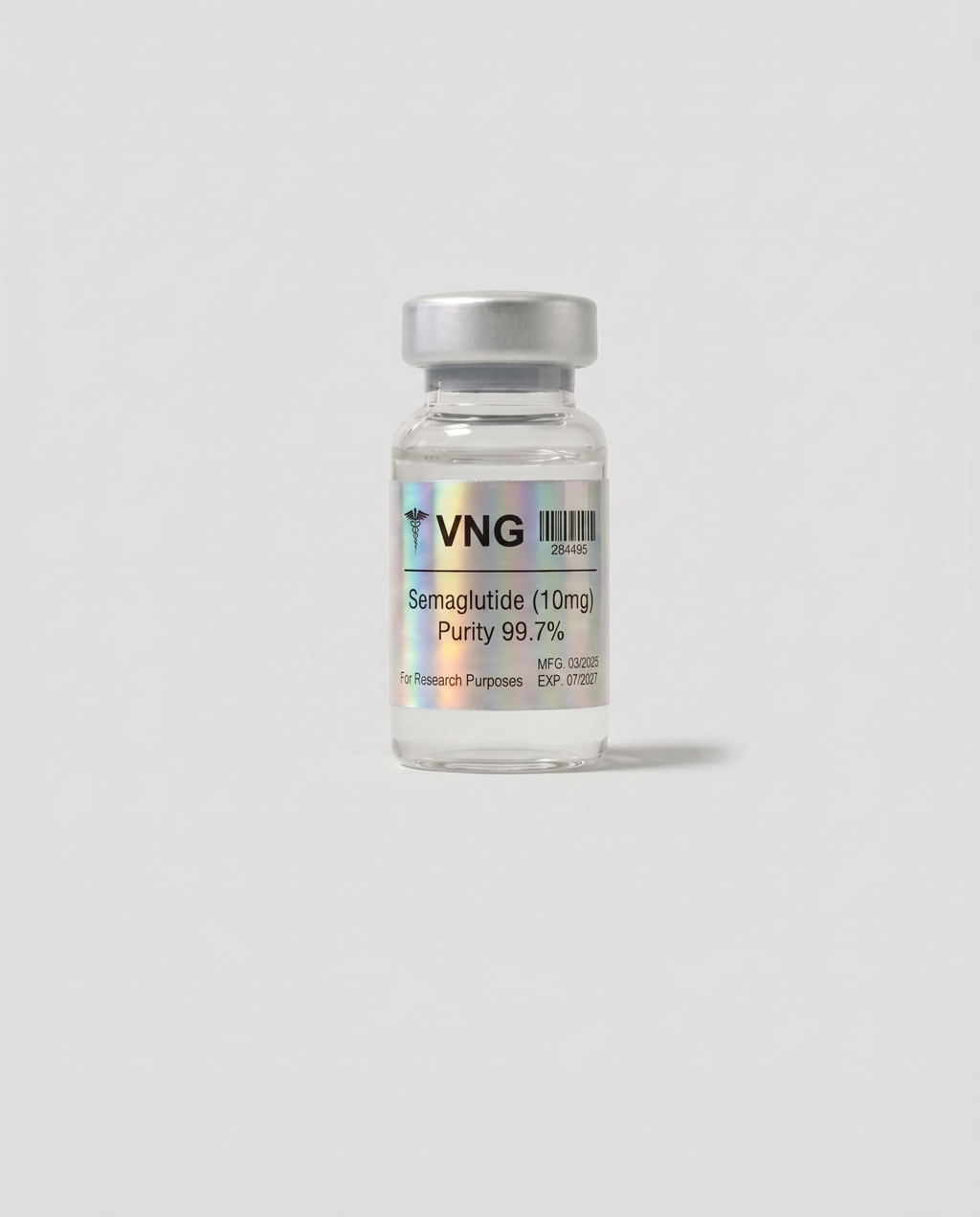
For research & educational purposes only. This article is a neutral, procedural reference for laboratory / in-vitro research handling — not medical advice or a usage recommendation. These materials are not for human or animal consumption.
On this page
What Semaglutide is
Semaglutide is a lab-made analog of GLP-1, a natural gut hormone released after eating. It is supplied as an analytical-grade reference material for laboratory research.
Where it comes from
Semaglutide was developed by Novo Nordisk as a longer-lasting successor to earlier GLP-1 analogs such as liraglutide. Chemists started from the natural GLP-1 hormone and made a few key changes: a substituted amino acid that shields it from the enzyme (DPP-4) that normally destroys GLP-1 within minutes, and a fatty-acid chain that lets it cling to the blood protein albumin. Together those tweaks stretch its active life to roughly a week. It reached the market as a diabetes and weight-management medicine (Ozempic, Rybelsus, Wegovy), and is supplied here only as a research reference material.
What it does — in plain terms
After a meal, your gut releases GLP-1 — a hormone that signals fullness to the brain and helps the pancreas manage blood sugar. Semaglutide is engineered to copy that GLP-1 signal and to resist being broken down, so it stays active far longer than the natural hormone. Researchers study how switching on the GLP-1 receptor affects appetite signaling, insulin and glucose handling, and body-weight change — it sits behind a large share of recent metabolic-science trials, which have also examined cardiovascular and liver outcomes.
How it works
Semaglutide targets a single receptor — the GLP-1 receptor — but is engineered to stimulate it for far longer than the natural hormone can. Natural GLP-1 is broken down within a couple of minutes by an enzyme called DPP-4; semaglutide's modifications let it dodge that enzyme and bind to albumin in the blood, so a single dose stays active for about a week.
Once it engages the GLP-1 receptor, research describes semaglutide signaling fullness to appetite centers in the brain, slowing how quickly the stomach empties, prompting glucose-dependent insulin release from the pancreas, and dampening the counter-hormone glucagon. Together these actions lower blood sugar and produce body-weight change in trials.
Because GLP-1 receptors also sit on tissues beyond the gut and pancreas — including in the cardiovascular system and the liver — researchers have examined semaglutide's effects well beyond glucose. Its clinical program has looked at cardiovascular events and at metabolic fatty-liver disease, making it one of the most broadly studied compounds in modern metabolic science.
What the research shows
Semaglutide has one of the deepest clinical evidence bases of any compound in this catalog — large randomized human trials spanning blood sugar, body weight, cardiovascular events, and liver disease, rather than the animal or cell studies that dominate much peptide research. It is still worth being honest that these effects come with well-documented gastrointestinal side effects. Here is what some of the key published work reports.
- The New England Journal of Medicine, 2021 — compared once-weekly semaglutide with tirzepatide for blood-glucose control and body weight in people with type 2 diabetes.
- The New England Journal of Medicine, 2025 — reported improvement of metabolic dysfunction-associated steatohepatitis in a Phase 3 trial.
- The New England Journal of Medicine, 2023 — reported fewer cardiovascular events with semaglutide in adults who had obesity but not diabetes, in the SELECT trial.
- Frontiers in Endocrinology, 2021 — reviewed the safety profile of semaglutide, including its common gastrointestinal side effects.
What Semaglutide is studied for
Blood-glucose control. Semaglutide has been studied extensively in type 2 diabetes research, including head-to-head against tirzepatide, for its effect on long-term glucose control.
Body-weight change in metabolic trials. Large trials have measured semaglutide's effect on body weight through its action on appetite and the GLP-1 receptor, a central theme in recent metabolic science.
Cardiovascular outcomes. The SELECT trial examined whether semaglutide affects cardiovascular events in adults with obesity but without diabetes, reporting a reduction in such events — a landmark result for the field.
Metabolic fatty-liver disease. A Phase 3 trial studied semaglutide in metabolic dysfunction-associated steatohepatitis (MASH), extending the research beyond glucose and body weight.
Storage & handling
Supplied as a lyophilized (freeze-dried) powder, semaglutide reference material keeps best cold and dark — refrigerated for short-term storage, or frozen for longer holds. Once reconstituted with bacteriostatic water, store it refrigerated at roughly 2-8 °C, protected from light, and avoid repeated freeze-thaw cycles, which degrade the peptide. See the reconstitution reference below to work out the concentration.
Plain-language explanations describe what researchers study — not what any product does for a person, and not medical advice. Every material here is sold for laboratory research use only and is not for human or animal use.
Reconstitution reference
Standard laboratory reconstitution volumes for Semaglutide, from the VNG Reconstitution Sheet. See the full reconstitution guide for the method and concentration math.
| Product | Vial | Bacteriostatic water | Resulting concentration |
|---|---|---|---|
| Semaglutide | 5 mg | 0.5 mL | 10 mg/mL |
| Semaglutide | 10 mg | 1 mL | 10 mg/mL |
Frequently asked questions
What is semaglutide?
Semaglutide is a lab-made analog of GLP-1, a gut hormone released after eating. It is engineered to resist rapid breakdown so it stays active for about a week. It is supplied here as an analytical-grade reference material for laboratory research use only.
How does semaglutide work?
Semaglutide switches on the GLP-1 receptor, which in research signals fullness to the brain, slows stomach emptying, prompts glucose-dependent insulin release, and dampens the hormone glucagon. These combined actions lower blood sugar and drive body-weight change in trials.
Is semaglutide supported by clinical trials?
Extensively. It has one of the deepest human-trial evidence bases in this catalog, spanning blood-glucose control, body-weight change, cardiovascular events, and metabolic fatty-liver disease. As with the whole class, these benefits come alongside well-documented gastrointestinal side effects.
Is it the same as Ozempic or Wegovy?
Those are approved medicines built on semaglutide. What we supply is analytical-grade semaglutide reference material for laboratory research use only — not a medicine, not for personal use, and not accompanied by any medical or dosing advice.
How does it compare with tirzepatide?
Semaglutide targets one receptor (GLP-1); tirzepatide targets two (GIP and GLP-1). They have been compared head-to-head in trials for both glucose control and body-weight change. Both are central compounds in modern metabolic research.
Published research
A selection of peer-reviewed and clinical literature indexed on PubMed. Provided so qualified researchers can locate the primary sources — inclusion here is not a claim about any product or outcome.
- Human trialThe New England journal of medicine · 2021
Tirzepatide versus semaglutide once weekly in patients with type 2 diabetes
View on PubMed - Human trialThe New England journal of medicine · 2025
Phase 3 trial of semaglutide in metabolic dysfunction-associated steatohepatitis
View on PubMed - Human trialThe New England journal of medicine · 2023
Semaglutide and cardiovascular outcomes in obesity without diabetes (SELECT trial)
View on PubMed - Peer-reviewed reviewFrontiers in endocrinology · 2021
Safety of semaglutide
View on PubMed
References & resources
Continue reading
Related reference materials
VNG Research Team
VNG Labs supplies analytical-grade reference materials with lot-matched Certificates of Analysis. Our write-ups are neutral, source-cited references for qualified and independent researchers.
More from LearnResearch use only. Not for human consumption or veterinary use. Sold exclusively to qualified researchers for in vitro and laboratory research. These statements have not been evaluated by the FDA. Not intended to diagnose, treat, cure, or prevent any disease. Refrigerate upon receipt. Keep in dark environment.