
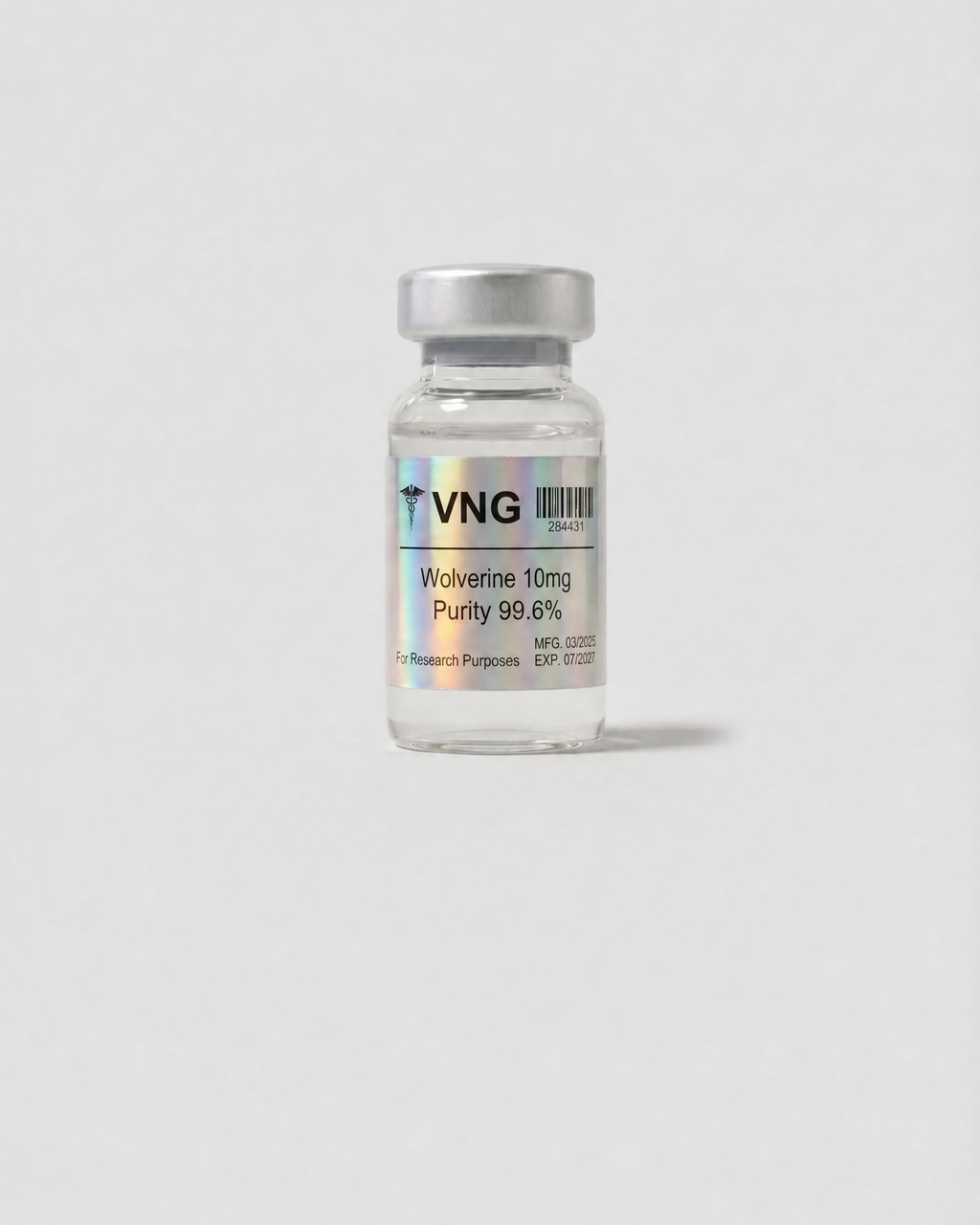
For research & educational purposes only. This article is a neutral, procedural reference for laboratory / in-vitro research handling — not medical advice or a usage recommendation. These materials are not for human or animal consumption.
On this page
What Wolverine Blend is
Wolverine Blend pairs two of the most-studied repair peptides: BPC-157 and TB-500 (a fragment of thymosin beta-4). It is supplied as an analytical-grade reference material for laboratory research.
Where it comes from
Wolverine Blend is a research blend of two separately discovered repair peptides, BPC-157 and TB-500, rather than a single compound. BPC-157 — short for Body Protection Compound 157 — is a synthetic 15-amino-acid sequence identified in the 1990s from a protective protein in human gastric juice, and it proved unusually stable outside the body. TB-500 is a lab-made copy of the active region of thymosin beta-4, a natural protein the body uses for building and repair. The two are frequently paired in recovery research because they approach tissue repair from complementary directions.
What it does — in plain terms
This blend pairs two compounds that researchers study around tissue repair from different angles. BPC-157 is a fragment copied from a protective stomach protein, studied for tendon, muscle, and gut-lining repair; TB-500 is the active piece of thymosin beta-4, studied for wound healing, cell migration, and new blood-vessel growth. The point of a blend is to look at how they behave together rather than one at a time. For the primary studies behind each ingredient, open its own post.
How it works
This blend pairs two of the most-studied repair peptides, and the logic is that they reach overlapping goals by different routes. Neither works through a single shared receptor with the other; instead, BPC-157 is studied mainly around blood supply and repair signaling, while TB-500 is studied around the movement of repair cells. Pairing them is a common research design, but the combination itself has not been validated as a blend — the evidence is on each peptide on its own.
BPC-157 behaves in animal and cell studies like a repair dispatcher: it does not appear to force a new process so much as speed the healing the body already knows how to do, above all by promoting new blood-vessel growth (angiogenesis) through the VEGF pathway. Because injured tissue can only rebuild when it receives oxygen and nutrients, that vascular effect is the most consistent thread in its literature.
TB-500 comes at repair from the cell-movement side. As the active fragment of thymosin beta-4, it binds actin — a core building block of a cell's internal scaffolding — and is studied for helping repair cells migrate into damaged tissue, with new blood-vessel formation as a secondary theme. So the two overlap on angiogenesis but reach it differently: BPC-157 via the VEGF signal, TB-500 via cell migration and actin. The primary studies for each are in their own posts.
What the research shows
Unlike its two ingredients, this blend has not been studied as a combination — so the honest evidence base is the separate literature on BPC-157 and TB-500, most of which is preclinical (cell and animal work). The studies below are split evenly between the two: three concern the BPC-157 component and three concern thymosin beta-4, the parent protein of the TB-500 component. Each is about a single ingredient, not the blend.
- Pharmaceuticals, 2025 — reviewed published literature and patents on medical-research applications of the BPC-157 component.
- Cell and Tissue Research, 2019 — reviewed the BPC-157 component's effects on musculoskeletal soft-tissue healing, describing accelerated tendon, ligament, and muscle recovery in animal models.
- Frontiers in Pharmacology, 2021 — surveyed the BPC-157 component's role in wound-healing research across preclinical models.
- Annals of the New York Academy of Sciences, 2007 — gave an overview of the beta-thymosins, the protein family that includes thymosin beta-4 — the source of the TB-500 component.
- International Immunopharmacology, 2023 — reviewed thymosin beta-4 (the parent protein of the TB-500 component) in regenerative-research settings.
- Annals of the New York Academy of Sciences, 2010 — summarized animal studies of thymosin beta-4 (the TB-500 component) as a tissue-repair peptide.
What Wolverine Blend is studied for
Tendon, muscle, and soft-tissue repair — BPC-157. The most-studied use of the BPC-157 component: in animal models it speeds the healing of slow-mending tissues like tendon and muscle, which have a poor blood supply of their own.
Wound healing and cell migration — TB-500. The TB-500 component is examined for helping repair cells migrate into a wound, drawing on the actin-binding role of its parent protein thymosin beta-4.
New blood-vessel growth (angiogenesis) — both. Angiogenesis is the point where the two literatures meet: BPC-157 through the VEGF pathway and TB-500 as a secondary theme, which is much of the rationale for pairing them.
Recovery-research models — the blend. The pair is popular in recovery-focused research precisely because the two peptides are thought to cover repair from different angles, though the combination remains untested as a unit.
Storage & handling
As a lyophilized (freeze-dried) powder, this two-peptide reference material is most stable kept cold and dark — refrigerated, or frozen for longer holds. Once reconstituted with bacteriostatic water it should be refrigerated at roughly 2-8 °C, kept out of light, and protected from repeated freeze-thaw cycles, which are hard on peptide mixtures. Because it is a blend of two peptides, use it promptly once reconstituted. See the reconstitution reference below for the concentration math.
Plain-language explanations describe what researchers study — not what any product does for a person, and not medical advice. Every material here is sold for laboratory research use only and is not for human or animal use.
Reconstitution reference
Standard laboratory reconstitution volumes for Wolverine Blend, from the VNG Reconstitution Sheet. See the full reconstitution guide for the method and concentration math.
| Product | Vial | Bacteriostatic water | Resulting concentration |
|---|---|---|---|
| BPC-157 | 10 mg | 2 mL | 5 mg/mL |
| GLOW (GHK-Cu + BPC-157 + TB-500) | 70 mg | 3 mL | ~23.3 mg/mL |
| KLOW (BPC-157 + GHK-Cu + TB-500 + KPV) | 80 mg | 3 mL | ~26.7 mg/mL |
Frequently asked questions
What is Wolverine Blend?
Wolverine Blend is a research blend of two of the most-studied repair peptides — BPC-157 and TB-500 (a fragment of thymosin beta-4). It is supplied here as an analytical-grade reference material for laboratory research use only.
Is the blend itself supported by human trials?
No. The BPC-157 and TB-500 combination has not been studied as a blend in people, and even the individual peptides are supported mainly by preclinical (animal and cell) research rather than rigorous human trials. It should be viewed as a research tool, not a proven combination.
Why are these two peptides paired?
BPC-157 and TB-500 are studied for tissue repair from complementary angles — BPC-157 mainly around blood supply and repair signaling, TB-500 around repair-cell migration — with new blood-vessel growth as a shared theme. That overlap is the usual rationale for combining them in recovery research.
Where can I read the primary studies?
Each ingredient has its own detailed post: the BPC-157 post covers tendon, muscle, and gut-lining repair research, and the TB-500 post covers wound healing, cell migration, and blood-vessel growth. This page focuses on how the two are thought to work together.
How is it handled in the lab?
Glutathione ships as a lyophilized powder, stored cold and dark, and is reconstituted with bacteriostatic water before use in laboratory research. It is a reference material for research use only and is not for human or veterinary use.
Published research
A selection of peer-reviewed and clinical literature indexed on PubMed. Provided so qualified researchers can locate the primary sources — inclusion here is not a claim about any product or outcome.
- Peer-reviewed reviewPharmaceuticals (Basel, Switzerland) · 2025
BPC-157 peptide: medical applications — literature & patent review
View on PubMed - Peer-reviewed studyCell and tissue research · 2019
BPC-157 and musculoskeletal soft-tissue healing
View on PubMed - Peer-reviewed studyFrontiers in pharmacology · 2021
BPC-157 and wound healing
View on PubMed - Peer-reviewed studyAnnals of the New York Academy of Sciences · 2007
Beta-thymosins overview (thymosin beta-4 / TB-500)
View on PubMed - Peer-reviewed studyInternational immunopharmacology · 2023
Thymosin beta-4 in regenerative-therapy research
View on PubMed - Peer-reviewed studyAnnals of the New York Academy of Sciences · 2010
Thymosin beta-4 tissue-repair peptide — animal studies
View on PubMed
References & resources
Continue reading
Related reference materials
VNG Research Team
VNG Labs supplies analytical-grade reference materials with lot-matched Certificates of Analysis. Our write-ups are neutral, source-cited references for qualified and independent researchers.
More from LearnResearch use only. Not for human consumption or veterinary use. Sold exclusively to qualified researchers for in vitro and laboratory research. These statements have not been evaluated by the FDA. Not intended to diagnose, treat, cure, or prevent any disease. Refrigerate upon receipt. Keep in dark environment.