
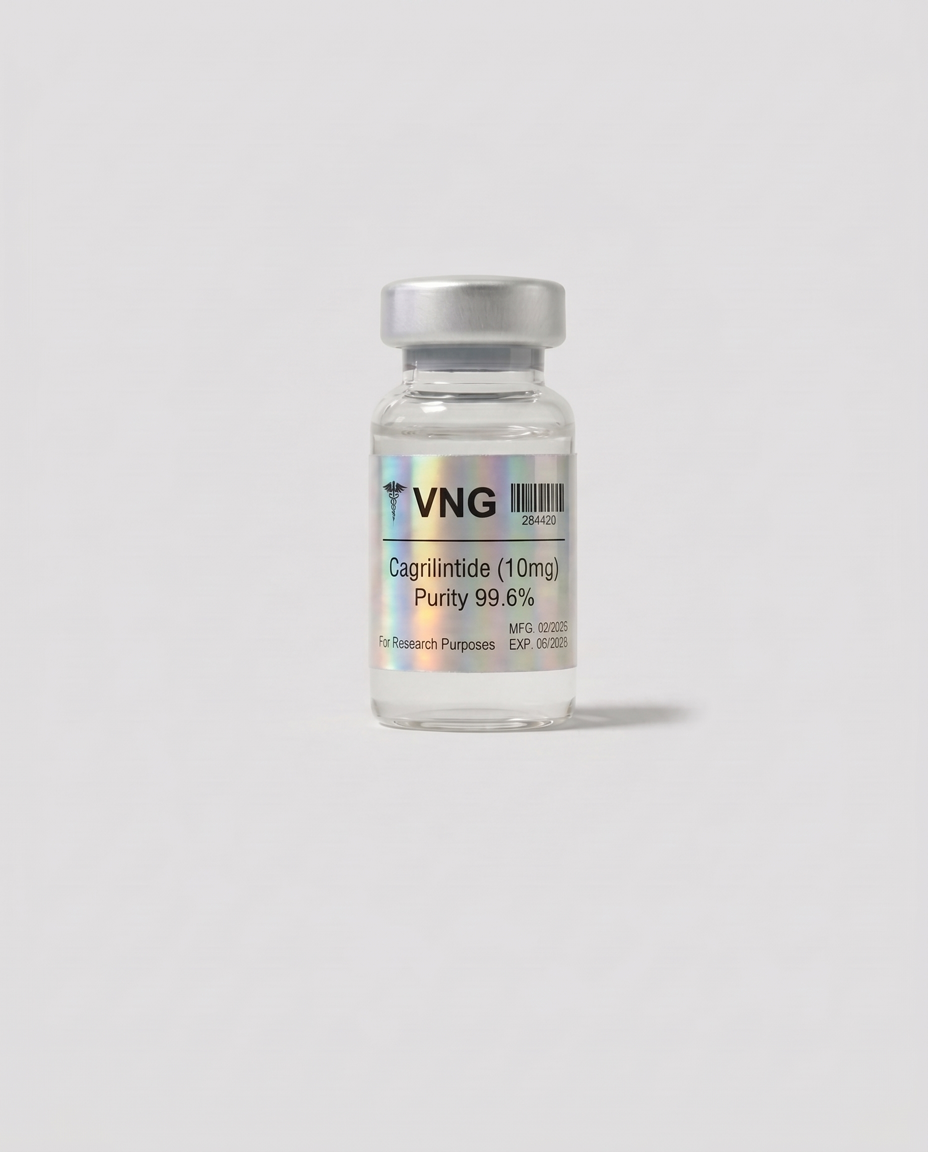
For research & educational purposes only. This article is a neutral, procedural reference for laboratory / in-vitro research handling — not medical advice or a usage recommendation. These materials are not for human or animal consumption.
On this page
What Cagrilintide is
Cagrilintide is a synthetic, long-acting analogue of amylin, a hormone the pancreas releases with insulin after a meal. A fatty-acid chain lets it bind albumin in the blood, which is what stretches its action to about a week. It is supplied as an analytical-grade reference material for laboratory research.
Where it comes from
Amylin itself was identified in the 1980s, but the natural hormone clears from the blood in minutes, which made it an awkward research tool. Cagrilintide was designed at Novo Nordisk as a stabilised amylin analogue carrying a C20 fatty-diacid side chain, the same lipidation idea used in semaglutide. The 2021 medicinal-chemistry paper describes how the sequence was altered to resist breakdown and to keep the molecule from forming fibrils, while the side chain gave it a half-life long enough for once-weekly dosing.
What it does — in plain terms
Amylin is one of the signals that tells the brain a meal has arrived. In research, cagrilintide acts on the same amylin receptors, and trial participants receiving it ate less and their body weight changed in a dose-dependent way. Much of the current interest is in pairing it with a GLP-1 analogue, because the two signals reach the brain by different routes.
How it works
Amylin receptors are built from a calcitonin receptor plus a small partner protein called a RAMP. Cagrilintide binds these receptor complexes, and a 2025 mechanism study in mice traced the body-weight effect specifically to amylin receptors 1 and 3 in the brain.
The downstream picture is a satiety signal: activity in the area postrema and related brainstem regions, slower gastric emptying, and reduced food intake. This is a different pathway from GLP-1 receptor agonists, which is the rationale for studying the two together.
Because the molecule is albumin-bound, its concentration in blood rises and falls slowly. Trial protocols therefore escalate the dose over weeks, and the phase 1 combination study looked closely at how the two long-acting molecules behaved side by side.
What the research shows
Cagrilintide is unusual among research peptides in having a large, published human-trial record: a phase 2 dose-finding trial, a phase 1 combination study, and phase 3 trials of the cagrilintide plus semaglutide pairing. The honest caveat is that all of this comes from one sponsor's development programme, and the peptide is not an approved product on its own.
- Lancet, 2021 — in a 26-week, placebo- and active-controlled dose-finding trial, once-weekly cagrilintide produced dose-dependent body-weight change versus placebo, with the highest doses comparing favourably with the active control.
- Journal of Medicinal Chemistry, 2021 — described the design of cagrilintide: sequence changes for stability and against fibril formation, plus a fatty-diacid side chain for albumin binding and a week-long action.
- EBioMedicine, 2025 — showed in mice that cagrilintide's effect on body weight depends on amylin receptors 1 and 3 in the brain, narrowing down where the signal acts.
- Lancet, 2021 (phase 1) — tested multiple doses of cagrilintide given alongside semaglutide 2.4 mg, reporting on safety, tolerability and the pharmacokinetics of the two molecules together.
- New England Journal of Medicine, 2025 — reported a phase 3 trial of co-administered cagrilintide and semaglutide in adults with overweight or obesity, the largest published test of the pairing.
What Cagrilintide is studied for
Body-weight change. The central question of the trial programme. Results are reported as the percentage change in body weight over the trial period against placebo, not as a treatment claim.
Amylin-receptor signalling. Cell and animal work maps which receptor complexes the molecule binds and which brain regions carry the effect, most recently pointing at amylin receptors 1 and 3.
Co-administration with semaglutide. Because amylin and GLP-1 signal through different routes, the combination has been studied from phase 1 through phase 3 to see whether the effects add.
Appetite and energy intake. Trial sub-studies and animal work measure food intake and gastric emptying to explain how the weight change comes about.
Storage & handling
As a lyophilized (freeze-dried) powder, cagrilintide reference material is most stable kept cold and dark, refrigerated or frozen for longer holds. Once reconstituted with bacteriostatic water it should be refrigerated at roughly 2-8 °C, kept out of light, and protected from repeated freeze-thaw cycles. See the VNG reconstitution guide for the concentration math.
Plain-language explanations describe what researchers study — not what any product does for a person, and not medical advice. Every material here is sold for laboratory research use only and is not for human or animal use.
Frequently asked questions
What is cagrilintide?
Cagrilintide is a synthetic, long-acting analogue of the hormone amylin, lipidated so that it binds albumin and acts for about a week. It is supplied here as an analytical-grade reference material for laboratory research use only.
How does cagrilintide work in research?
It binds amylin receptors (calcitonin receptor plus RAMP complexes). A 2025 mouse study traced its body-weight effect to amylin receptors 1 and 3 in the brain, where the signal reads as satiety and slows gastric emptying.
What has cagrilintide been studied for?
Body-weight change in a phase 2 dose-finding trial, and co-administration with semaglutide in phase 1 and phase 3 trials. It is not an approved product on its own.
Is cagrilintide the same as semaglutide?
No. Semaglutide is a GLP-1 receptor agonist; cagrilintide is an amylin analogue. They act through different receptors, which is exactly why researchers study them together.
How is cagrilintide stored and reconstituted?
Keep the lyophilized powder cold and dark; reconstitute with bacteriostatic water and refrigerate the solution at about 2-8 °C, avoiding repeated freeze-thaw cycles.
Published research
A selection of peer-reviewed and clinical literature indexed on PubMed. Provided so qualified researchers can locate the primary sources — inclusion here is not a claim about any product or outcome.
- Phase 2 randomised trialLancet · 2021
Once-weekly cagrilintide for weight management in people with overweight and obesity: a multicentre, randomised, double-blind, placebo-controlled and active-controlled, dose-finding phase 2 trial
View on PubMed - Design and chemistryJournal of Medicinal Chemistry · 2021
Development of Cagrilintide, a Long-Acting Amylin Analogue
View on PubMed - Mechanism studyEBioMedicine · 2025
Cagrilintide lowers bodyweight through brain amylin receptors 1 and 3
View on PubMed - Phase 1 randomised trialLancet · 2021
Safety, tolerability, pharmacokinetics, and pharmacodynamics of concomitant administration of multiple doses of cagrilintide with semaglutide 2.4 mg for weight management
View on PubMed - Phase 3 randomised trialNew England Journal of Medicine · 2025
Coadministered Cagrilintide and Semaglutide in Adults with Overweight or Obesity
View on PubMed
References & resources
Related reference materials
VNG Research Team
VNG Labs supplies analytical-grade reference materials with lot-matched Certificates of Analysis. Our write-ups are neutral, source-cited references for qualified and independent researchers.
More from LearnResearch use only. Not for human consumption or veterinary use. Sold exclusively to qualified researchers for in vitro and laboratory research. These statements have not been evaluated by the FDA. Not intended to diagnose, treat, cure, or prevent any disease. Refrigerate upon receipt. Keep in dark environment.