
For research & educational purposes only. This article is a neutral, procedural reference for laboratory / in-vitro research handling — not medical advice or a usage recommendation. These materials are not for human or animal consumption.
On this page
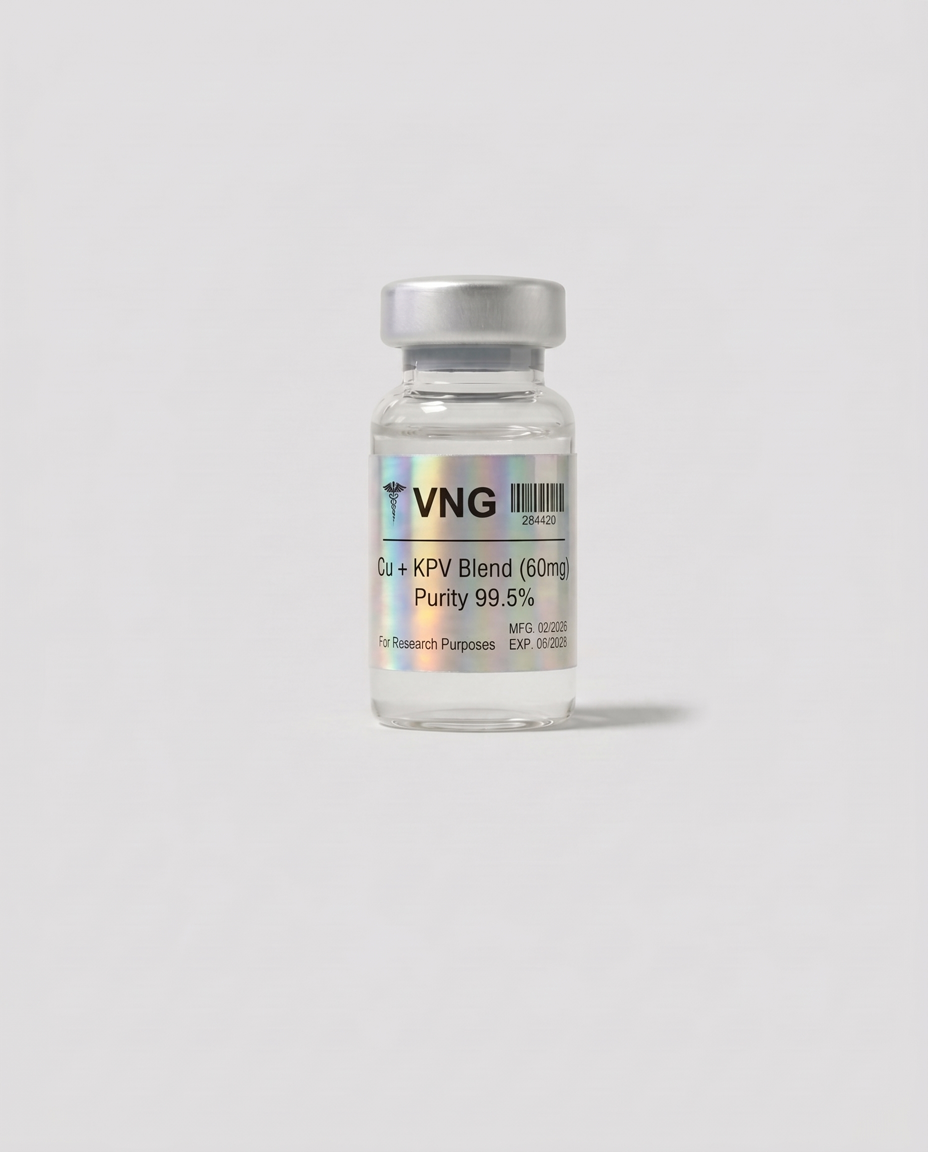
What Cu + KPV Blend is
This blend combines GHK-Cu, the copper-binding tripeptide glycyl-histidyl-lysine, with KPV, the three-residue C-terminal fragment of alpha-melanocyte-stimulating hormone. Each is supplied as an analytical-grade reference material for laboratory research; the combination has not itself been studied and the evidence below is for the two components separately.
Where it comes from
GHK was identified in 1973 by Loren Pickart, who noticed that a factor in young human plasma changed how liver cells behaved and traced it to the tripeptide, which binds copper tightly. Its concentration in plasma falls with age, which drove decades of skin and repair research. KPV is the last three residues (Lys-Pro-Val) of alpha-MSH; researchers found in the 1990s that this fragment kept much of the parent hormone's anti-inflammatory activity while losing its pigmentation and appetite effects.
What it does — in plain terms
GHK-Cu is best known from skin and wound research, where it is studied for collagen production, remodelling and anti-inflammatory signalling, and more recently in lung-fibrosis models. KPV is studied almost entirely for inflammation: in animal models of colitis and oral mucositis it dampened inflammatory signalling without the hormonal effects of the full alpha-MSH molecule. Together they are two anti-inflammatory research tools with different mechanisms.
How it works
GHK-Cu carries copper into cells and tissues in a form they can use, and in cell and animal studies it shifts gene expression toward repair: more collagen and glycosaminoglycan production, modulated matrix-remodelling enzymes, and lower markers of oxidative stress and inflammation. Formulation studies in liposomes and microspheres look at how to get it through skin and into tissue.
KPV works differently. It reduces activation of NF-kB, a master switch for inflammatory genes, in epithelial and immune cells, and in colitis models it lowered inflammatory cytokines and tissue damage. A 2021 study delivered it in a hydrogel to oral mucosa.
Because the two act on different parts of the inflammatory and repair machinery, the blend puts two reference materials in one vial; no published study has tested them together, so any combined effect is an inference.
What the research shows
Both components have a genuine and mostly preclinical literature. GHK-Cu's is broad and includes a large body of cosmetic-formulation work as well as animal repair and lung models; KPV's is narrower and centred on inflammation in the gut and mouth. Neither has substantial human clinical-trial evidence, and the combination has none.
- Pharmaceutics, 2023 — studied GHK-Cu in liposomal formulations for skin, characterising stability and delivery of the copper peptide.
- Redox Biology, 2024 — examined GHK-Cu in models of lung inflammation and fibrosis, reporting effects on inflammatory and oxidative-stress markers.
- Journal of Orthopaedic Research, 2015 — reported that GHK-Cu influenced healing of the anterior cruciate ligament in a rat model.
- Inflammatory Bowel Diseases, 2008 — showed that the tripeptide KPV reduced intestinal inflammation in an animal model of colitis, with lower inflammatory signalling in the gut lining.
- Biomaterials Science, 2021 — delivered KPV in a hydrogel to study oral mucositis in an animal model, reporting reduced inflammation at the site.
What Cu + KPV Blend is studied for
Skin and wound research. GHK-Cu's largest literature: collagen and matrix production, remodelling, and formulation work on getting the peptide through skin.
Lung inflammation and fibrosis. Animal models in which GHK-Cu reduced inflammatory and oxidative markers and fibrotic change.
Intestinal inflammation. KPV's core evidence: colitis models in which the tripeptide lowered NF-kB-driven inflammation and tissue injury.
Oral mucositis. A hydrogel delivery study of KPV in an animal model of mucositis, reporting less inflammation at the mucosa.
Storage & handling
As a lyophilized (freeze-dried) powder the blend is most stable kept cold and dark, refrigerated or frozen for longer holds. Once reconstituted with bacteriostatic water it should be refrigerated at roughly 2-8 °C, kept out of light, and protected from repeated freeze-thaw cycles. The copper complex gives the reconstituted solution a faint blue tint.
Plain-language explanations describe what researchers study — not what any product does for a person, and not medical advice. Every material here is sold for laboratory research use only and is not for human or animal use.
Reconstitution reference
Standard laboratory reconstitution volumes for Cu + KPV Blend, from the VNG Reconstitution Sheet. See the full reconstitution guide for the method and concentration math.
| Product | Vial | Bacteriostatic water | Resulting concentration |
|---|---|---|---|
| GHK-Cu | 50 mg | 1.5 mL | ~33.3 mg/mL |
| GHK-Cu | 100 mg | 3 mL | ~33.3 mg/mL |
| AHK-Cu | 50 mg | 1.5 mL | ~33.3 mg/mL |
| AHK-Cu | 100 mg | 3 mL | ~33.3 mg/mL |
| GLOW (GHK-Cu + BPC-157 + TB-500) | 70 mg | 3 mL | ~23.3 mg/mL |
| KLOW (BPC-157 + GHK-Cu + TB-500 + KPV) | 80 mg | 3 mL | ~26.7 mg/mL |
Frequently asked questions
What is in the Cu + KPV blend?
GHK-Cu (50 mg), the copper-binding tripeptide glycyl-histidyl-lysine, and KPV (10 mg), the C-terminal tripeptide of alpha-MSH, together as analytical-grade reference material for laboratory research use only.
Has the combination itself been studied?
No. The published evidence covers each peptide separately; the blend is two reference materials in one vial.
What has GHK-Cu been studied for?
Skin and wound research (collagen production and remodelling), formulation and delivery, and animal models of lung inflammation and ligament healing. Most of it is preclinical or cosmetic.
What has KPV been studied for?
Inflammation, mainly in animal models of colitis and oral mucositis, where it reduced NF-kB-driven inflammatory signalling without the hormonal effects of full alpha-MSH.
How is the blend stored and reconstituted?
Keep the lyophilized powder cold and dark; reconstitute with bacteriostatic water, refrigerate at about 2-8 °C, and avoid repeated freeze-thaw cycles.
Published research
A selection of peer-reviewed and clinical literature indexed on PubMed. Provided so qualified researchers can locate the primary sources — inclusion here is not a claim about any product or outcome.
- Component study: GHK-CuPharmaceutics · 2023
GHK-Cu tripeptide in liposomes (cosmetic study)
View on PubMed - Component study: GHK-CuRedox Biology · 2024
GHK-Cu and lung inflammation / fibrosis
View on PubMed - Component study: GHK-CuJournal of Orthopaedic Research · 2015
GHK-Cu and ACL healing (rat model)
View on PubMed - Component study: KPVInflammatory Bowel Diseases · 2008
KPV tripeptide and inflammatory bowel disease (animal model)
View on PubMed - Component study: KPVBiomaterials Science · 2021
KPV hydrogel and oral mucositis
View on PubMed
References & resources
Related reference materials
VNG Research Team
VNG Labs supplies analytical-grade reference materials with lot-matched Certificates of Analysis. Our write-ups are neutral, source-cited references for qualified and independent researchers.
More from LearnResearch use only. Not for human consumption or veterinary use. Sold exclusively to qualified researchers for in vitro and laboratory research. These statements have not been evaluated by the FDA. Not intended to diagnose, treat, cure, or prevent any disease. Refrigerate upon receipt. Keep in dark environment.