
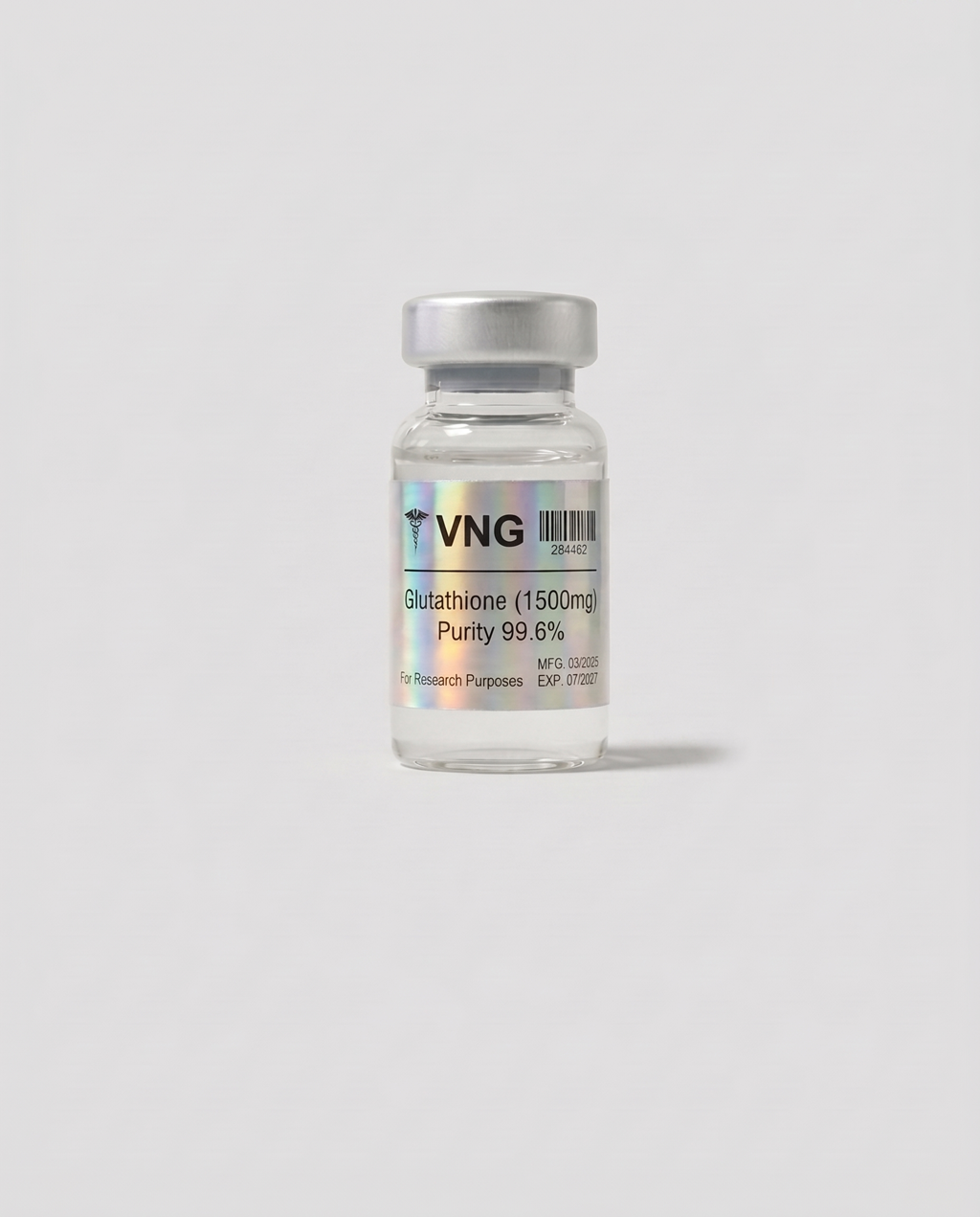
For research & educational purposes only. This article is a neutral, procedural reference for laboratory / in-vitro research handling — not medical advice or a usage recommendation. These materials are not for human or animal consumption.
On this page
What Glutathione is
Glutathione (GSH) is a small molecule that cells build from three amino acids (glutamate, cysteine, and glycine). It is supplied as an analytical-grade reference material for laboratory research.
Where it comes from
Glutathione was pieced together in the 1920s. In 1921 the biochemist Frederick Gowland Hopkins isolated it from tissues and first described it as a two-part molecule of glutamate and cysteine. Further work -- by Hopkins himself and others such as Edward Kendall -- corrected the picture by 1929, showing it is actually a tripeptide with glycine added on. Its structure holds a quirk: the glutamate is joined through an unusual 'gamma' peptide bond rather than the standard link, which helps make glutathione resistant to ordinary protein-cutting enzymes and stable enough to reach high levels inside cells.
What it does — in plain terms
Glutathione is the cell's most abundant built-in antioxidant. Its job is to neutralize reactive, damaging molecules (free radicals) and to keep the cell's internal chemistry in a balanced, 'reduced' state — think of it as the cleanup-and-rust-prevention crew. It also helps tag and clear toxins. Because that redox balance sits underneath so much of cell biology, glutathione is one of the most-studied molecules in research on oxidative stress, detoxification, and aging.
How it works
Glutathione's whole job rests on one reactive part: the thiol (-SH) group on its cysteine. That sulfur atom readily gives up an electron to neutralize reactive, damaging molecules such as free radicals. When it does, two glutathione molecules join into an oxidized form (GSSG); an enzyme called glutathione reductase then recharges them back to the active form using energy carried by NADPH. Cells keep glutathione at high concentrations and constantly recycle it, which is why it is described as the cell's master antioxidant.
Glutathione rarely works alone. Glutathione peroxidase enzymes use it to break down peroxides, while the GSH-to-GSSG ratio serves as a broad gauge of a cell's redox balance -- how oxidized or 'reduced' its internal chemistry is. That balance sits underneath countless other processes, from protein folding to signaling.
A second major role is detoxification. Through glutathione-S-transferase enzymes, glutathione is stitched onto reactive or foreign compounds, tagging them for safe disposal. Because building glutathione depends on a steady supply of cysteine, its scarcest ingredient, research often uses cysteine-delivering compounds such as N-acetylcysteine (NAC) to raise glutathione levels.
What the research shows
Glutathione's biochemistry is foundational and thoroughly established -- few molecules are as central to how cells manage oxidative stress. The honest caveat is on the applied side: much of the literature here is review and mechanistic work, and questions about how well supplemental glutathione is absorbed and whether it helps specific conditions in people are still being studied. The references below lean toward mechanism and biology rather than proven clinical outcomes.
- Biochimica et Biophysica Acta, 2013 — reviewed how cells synthesize glutathione from glutamate, cysteine, and glycine, and how that two-step, cysteine-limited process is regulated.
- Current Medicinal Chemistry, 2024 — provided an updated overview of glutathione's biosynthesis, metabolism, antioxidant functions, and research interest.
- JBRA Assisted Reproduction, 2018 — reviewed glutathione's role in countering oxidative stress, with a focus on reproductive biology and infertility research.
- Current Neuropharmacology, 2021 — reviewed N-acetylcysteine (NAC) -- a cysteine precursor used to raise glutathione -- across disorders marked by oxidative stress (note: this reference concerns the precursor NAC, not glutathione itself).
What Glutathione is studied for
Antioxidant defense. The cysteine thiol lets glutathione neutralize free radicals directly, making it the most abundant built-in antioxidant in the cell and a standard subject in oxidative-stress research.
Cellular redox balance. The ratio of reduced (GSH) to oxidized (GSSG) glutathione, recycled using NADPH, is widely used as a readout of a cell's overall redox state.
Detoxification. Via glutathione-S-transferase enzymes, glutathione is conjugated onto reactive or foreign molecules to tag them for clearance, a core part of phase-II detoxification.
Synthesis and the NAC connection. Because cysteine is the limiting ingredient, researchers often study cysteine-delivering compounds such as N-acetylcysteine as a way to support glutathione levels.
Storage & handling
Glutathione is a tripeptide, and its reactive thiol makes it prone to oxidation, so careful storage matters. As a lyophilized powder it is kept cold, dark, and sealed against moisture -- refrigerated for short holds or frozen for longer storage. Once reconstituted with bacteriostatic water it oxidizes more readily, so it should be refrigerated at about 2-8 C, protected from light and air, used promptly, and spared repeated freeze-thaw cycles. See the reconstitution reference below for concentrations.
Plain-language explanations describe what researchers study — not what any product does for a person, and not medical advice. Every material here is sold for laboratory research use only and is not for human or animal use.
Frequently asked questions
What is glutathione?
Glutathione (GSH) is a tripeptide built from glutamate, cysteine, and glycine, and it is the cell's most abundant natural antioxidant. It is supplied here as an analytical-grade reference material for laboratory research use only.
Is glutathione a peptide?
Technically yes -- it is a tripeptide, three amino acids linked together. But it acts as an antioxidant and detox molecule rather than a signaling peptide, and its glutamate is joined through an unusual gamma bond that ordinary protein-cutting enzymes cannot easily break.
How is glutathione related to NAC?
N-acetylcysteine (NAC) delivers cysteine, the scarcest of glutathione's three building blocks. Because cysteine supply limits how much glutathione a cell can make, NAC is frequently studied as a way to raise glutathione levels.
Is supplemental glutathione well supported in humans?
The core biochemistry is well established, but applied questions are not settled. How well glutathione taken as a supplement is absorbed, and whether it helps specific conditions, remain active research topics rather than proven outcomes.
How is VNG Labs' glutathione supplied and tested?
Glutathione is provided as an analytical-grade, lyophilized reference material for laboratory research use only, with third-party testing (Vanguard) for identity and purity. It is not a drug or supplement and is not intended for human or veterinary use.
Published research
A selection of peer-reviewed and clinical literature indexed on PubMed. Provided so qualified researchers can locate the primary sources — inclusion here is not a claim about any product or outcome.
- Peer-reviewed reviewBiochimica et biophysica acta · 2013
Glutathione synthesis
View on PubMed - Peer-reviewed reviewCurrent medicinal chemistry · 2024
An update on glutathione's biosynthesis, metabolism, functions, and medicinal purposes
View on PubMed - Peer-reviewed reviewJBRA assisted reproduction · 2018
The role of glutathione on oxidative stress and infertility
View on PubMed - Peer-reviewed reviewCurrent neuropharmacology · 2021
The multifaceted role of N-acetylcysteine (NAC) in disorders characterized by oxidative stress
View on PubMed
References & resources
Continue reading
Related reference materials
VNG Research Team
VNG Labs supplies analytical-grade reference materials with lot-matched Certificates of Analysis. Our write-ups are neutral, source-cited references for qualified and independent researchers.
More from LearnResearch use only. Not for human consumption or veterinary use. Sold exclusively to qualified researchers for in vitro and laboratory research. These statements have not been evaluated by the FDA. Not intended to diagnose, treat, cure, or prevent any disease. Refrigerate upon receipt. Keep in dark environment.