
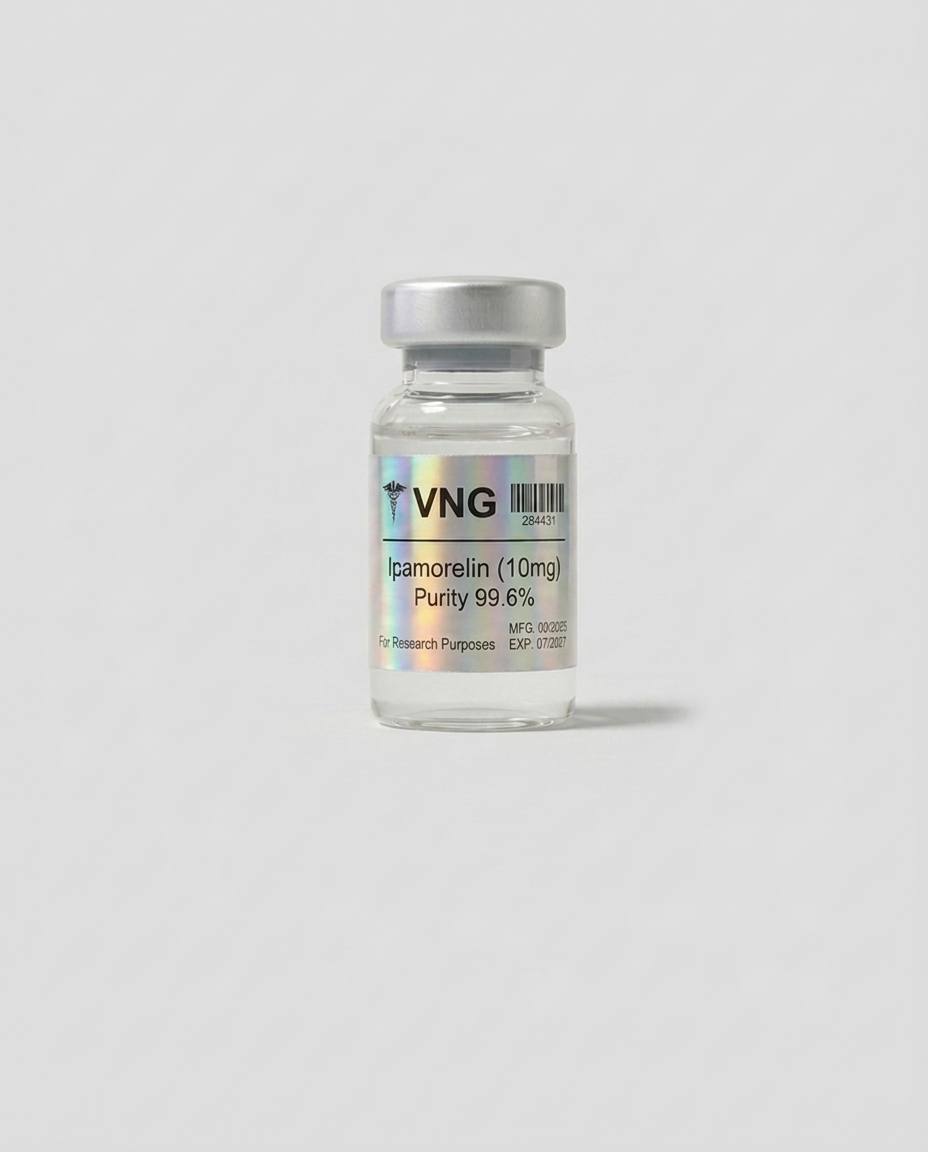
For research & educational purposes only. This article is a neutral, procedural reference for laboratory / in-vitro research handling — not medical advice or a usage recommendation. These materials are not for human or animal consumption.
On this page
What Ipamorelin is
Ipamorelin is a small lab-made pentapeptide (five amino acids) that acts as a selective growth-hormone secretagogue — a molecule that prompts the body to release its own growth hormone. It is supplied as an analytical-grade reference material for laboratory research.
Where it comes from
Ipamorelin came out of late-1990s work at the Danish pharmaceutical company Novo Nordisk to design a cleaner growth-hormone secretagogue. Researchers were building on the earlier 'growth-hormone-releasing peptides' (GHRPs) but wanted one that prompted a growth-hormone pulse without the side signals those earlier peptides carried. The result, first described in a 1998 paper in the European Journal of Endocrinology, was a small five-amino-acid peptide they called the first truly selective growth-hormone secretagogue. Its selectivity — releasing GH without meaningfully touching cortisol or prolactin — is what made it a lasting research tool.
What it does — in plain terms
Your body releases growth hormone in pulses, set off by 'go' signals. Ipamorelin mimics one of those signals — the ghrelin pathway — by binding the growth-hormone secretagogue receptor (GHS-R1a) on cells in the pituitary and prompting a pulse of growth hormone. What made it notable in the research is its selectivity: the foundational 1998 study described it as the first secretagogue to release growth hormone about as cleanly as the body's own GHRH, without meaningfully raising cortisol, prolactin, or other hormones even at doses far above the effective dose. That clean, targeted action is why it is a common tool for studying how the growth-hormone system is switched on, and it has also been examined in bone-growth and pharmacokinetic research.
How it works
The body releases growth hormone in bursts, shaped by opposing brain signals plus an amplifier. Ipamorelin works on the amplifier arm: it mimics ghrelin, the so-called 'hunger hormone,' by binding the growth-hormone secretagogue receptor (GHS-R1a) on hormone-producing cells in the pituitary gland. When it docks there, it prompts those cells to release a pulse of stored growth hormone.
What set ipamorelin apart in the original research is selectivity. Older growth-hormone-releasing peptides tended to nudge other pituitary outputs too — stress hormones like cortisol, or prolactin. The 1998 study reported that ipamorelin released growth hormone with a potency and specificity close to the body's own GHRH, without meaningfully raising cortisol or prolactin even at doses well above the effective one. In these animal and cell models it behaved like a targeted 'on' switch rather than a blunt one.
Because it acts through the ghrelin receptor rather than the GHRH receptor, ipamorelin is often studied alongside — or paired with — GHRH-type compounds such as CJC-1295, since the two press different buttons on the same system. Researchers also examined its downstream effects, most notably longitudinal bone growth in young rats, a readout of sustained growth-hormone and IGF-1 activity.
What the research shows
Ipamorelin's published literature is small and sits mostly at the pharmacology end: a foundational characterization, animal work on bone growth and the pituitary's hormone-producing cells, and a couple of early human pharmacokinetic studies. It is important to be clear that this is not a compound with large clinical-outcome trials behind it — most of what is known describes how it releases growth hormone and how it moves through the body, not proven benefits in people. With that caveat, here is what the key published work actually reports.
- European Journal of Endocrinology, 1998 — characterized ipamorelin as the first selective growth-hormone secretagogue, reporting that it released growth hormone in animal models about as cleanly as natural GHRH without meaningfully raising cortisol or prolactin.
- Growth Hormone & IGF Research, 1999 — found that ipamorelin induced longitudinal bone growth in rats, a measurable sign of sustained growth-hormone activity.
- Pharmaceutical Research, 1999 — built a pharmacokinetic-pharmacodynamic model of ipamorelin in human volunteers, describing how the peptide is cleared and how growth-hormone release tracks its levels.
- Xenobiotica, 1998 — evaluated the pharmacokinetics of ipamorelin and related peptidyl secretagogues, with particular attention to nasal absorption as a delivery route.
- Histology and Histopathology, 2002 — examined how prolonged administration of ipamorelin in young female rats affected the growth-hormone-producing (somatotroph) cells of the pituitary, studied in vitro.
What Ipamorelin is studied for
Selective growth-hormone release. The core of the research: ipamorelin binds the ghrelin receptor (GHS-R1a) to trigger a pulse of growth hormone, and the original work emphasized that it did so without meaningfully disturbing cortisol or prolactin.
Longitudinal bone growth. In young rats, ipamorelin promoted lengthening of bone — a classic downstream readout of growth-hormone and IGF-1 activity used to confirm the system is being switched on.
Pharmacokinetics and delivery. Early human and animal studies mapped how quickly ipamorelin is cleared and explored routes such as nasal absorption, groundwork for understanding how the peptide behaves in the body.
Pituitary (somatotroph) biology. Chronic-exposure studies looked at how the pituitary's growth-hormone-producing cells respond over time to repeated secretagogue signaling.
Storage & handling
As a lyophilized (freeze-dried) powder, ipamorelin reference material is most stable kept cold and dark — refrigerated for the near term, or frozen for longer storage. Once reconstituted with bacteriostatic water it should be held at roughly 2–8 °C, shielded from light, and protected from repeated freeze-thaw cycles, which are hard on peptides. Use the reconstitution reference below for the concentration math. Supplied for laboratory research use only.
Plain-language explanations describe what researchers study — not what any product does for a person, and not medical advice. Every material here is sold for laboratory research use only and is not for human or animal use.
Reconstitution reference
Standard laboratory reconstitution volumes for Ipamorelin, from the VNG Reconstitution Sheet. See the full reconstitution guide for the method and concentration math.
| Product | Vial | Bacteriostatic water | Resulting concentration |
|---|---|---|---|
| CJC-1295 + Ipamorelin | 5 mg + 5 mg | 2 mL | 5 mg/mL (of the blend) |
Frequently asked questions
What is ipamorelin?
Ipamorelin is a synthetic five-amino-acid peptide classed as a selective growth-hormone secretagogue — a molecule that prompts the pituitary to release its own growth hormone by acting on the ghrelin receptor (GHS-R1a). It is supplied here as an analytical-grade reference material for laboratory research use only.
What makes ipamorelin 'selective'?
In the foundational 1998 research, ipamorelin released growth hormone without meaningfully raising other pituitary hormones such as cortisol and prolactin, even at high doses. That clean, targeted action is why researchers describe it as selective, and why it became a useful tool for studying growth-hormone release on its own.
How does ipamorelin differ from GHRH analogs like CJC-1295?
Ipamorelin and the GHRH analogs press different buttons on the same system. GHRH analogs act on the GHRH receptor, while ipamorelin acts on the ghrelin (secretagogue) receptor. Because the two pathways are complementary, researchers often study them side by side or in combination.
Is ipamorelin supported by large human clinical trials?
Not substantially. The published evidence is dominated by foundational pharmacology, animal studies, and small human pharmacokinetic work describing how the peptide behaves — not large trials proving clinical benefits in people. That is an important caveat when interpreting it.
Is this product for human use?
No. It is sold strictly as a reference material for laboratory research use only — not for human or veterinary use, and not as a drug or supplement.
Published research
A selection of peer-reviewed and clinical literature indexed on PubMed. Provided so qualified researchers can locate the primary sources — inclusion here is not a claim about any product or outcome.
- Foundational studyEuropean Journal of Endocrinology · 1998
Ipamorelin, the first selective growth hormone secretagogue
View on PubMed - Animal studyGrowth Hormone & IGF Research · 1999
Ipamorelin, a new growth-hormone-releasing peptide, induces longitudinal bone growth in rats
View on PubMed - Human studyPharmaceutical Research · 1999
Pharmacokinetic-pharmacodynamic modeling of ipamorelin, a growth hormone releasing peptide, in human volunteers
View on PubMed - PharmacokineticsXenobiotica · 1998
Pharmacokinetic evaluation of ipamorelin and other peptidyl growth hormone secretagogues with emphasis on nasal absorption
View on PubMed - Animal studyHistology and Histopathology · 2002
Influence of chronic treatment with the growth hormone secretagogue Ipamorelin in young female rats: somatotroph response in vitro
View on PubMed
References & resources
Continue reading
Related reference materials
VNG Research Team
VNG Labs supplies analytical-grade reference materials with lot-matched Certificates of Analysis. Our write-ups are neutral, source-cited references for qualified and independent researchers.
More from LearnResearch use only. Not for human consumption or veterinary use. Sold exclusively to qualified researchers for in vitro and laboratory research. These statements have not been evaluated by the FDA. Not intended to diagnose, treat, cure, or prevent any disease. Refrigerate upon receipt. Keep in dark environment.