
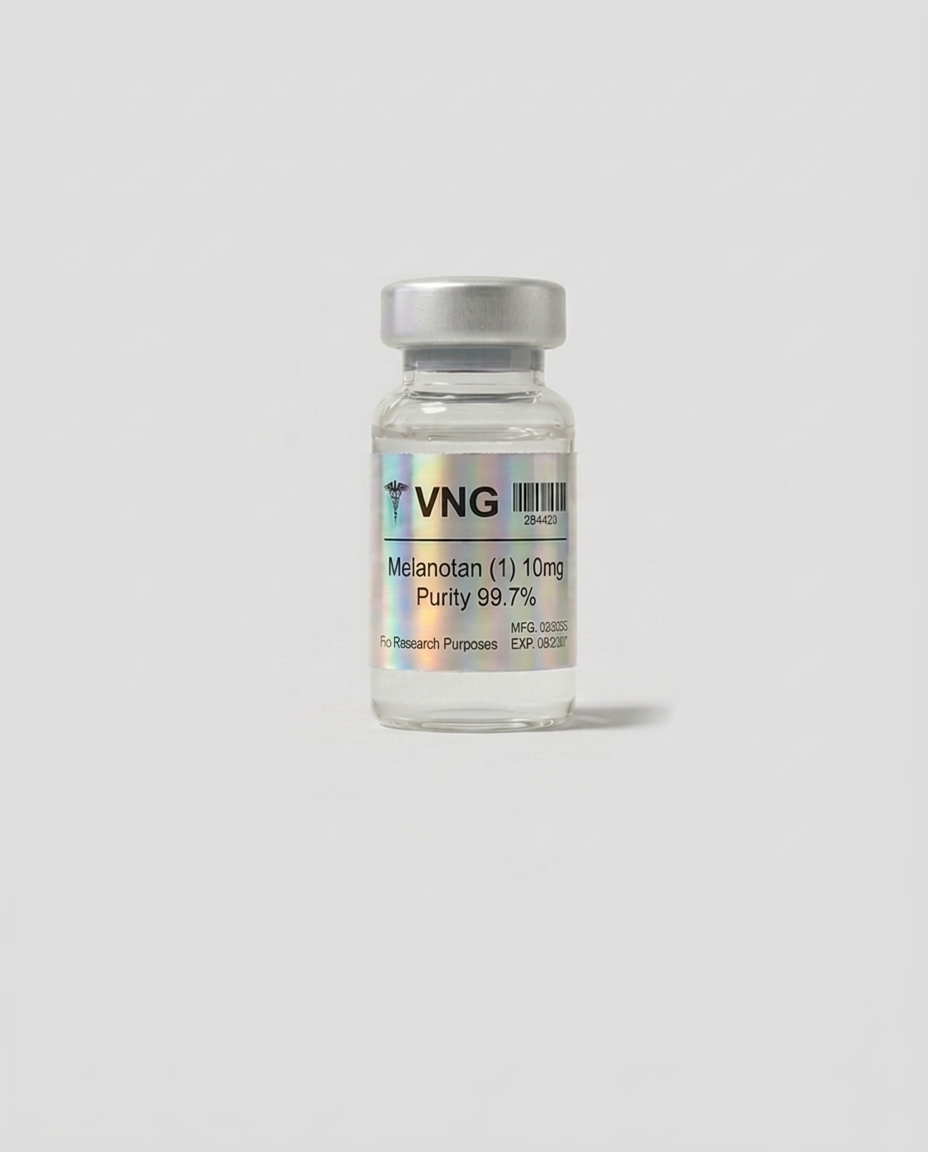
For research & educational purposes only. This article is a neutral, procedural reference for laboratory / in-vitro research handling — not medical advice or a usage recommendation. These materials are not for human or animal consumption.
On this page
What Melanotan I is
Melanotan I (also called afamelanotide) is a lab-made copy of a natural hormone (alpha-MSH) that controls skin pigment. It is supplied as an analytical-grade reference material for laboratory research.
Where it comes from
Melanotan I, known in medicine as afamelanotide, grew out of work at the University of Arizona in the 1980s. Researchers were looking for a more stable, longer-lasting version of alpha-melanocyte-stimulating hormone (alpha-MSH) — the natural signal that tells pigment cells to make melanin. By making a couple of targeted substitutions to the natural hormone's sequence, they produced a linear 13-amino-acid analog that resisted breakdown and acted more potently at the melanocortin-1 receptor. That molecule became Melanotan I, and it has since been developed into an approved therapy for a rare light-sensitivity disorder.
What it does — in plain terms
Your skin contains cells that make melanin — the pigment that darkens skin and helps shield it from UV light. Melanotan I imitates the natural signal that switches those cells on. So researchers study it around pigmentation and photoprotection: how skin produces pigment, and whether more of it can help protect against sun damage.
How it works
Melanotan I works by imitating alpha-MSH at the melanocortin-1 receptor (MC1R), which sits on the surface of the skin's pigment cells (melanocytes). When that receptor is switched on, the cell ramps up production of eumelanin — the darker, more photoprotective form of melanin. Because the analog is more stable than the natural hormone, it keeps this signal going longer than alpha-MSH would.
The reason this matters for research is photoprotection. Eumelanin absorbs and scatters ultraviolet light and helps neutralize some of the reactive molecules UV creates, so increasing it is a way to study whether skin can be made more resistant to light-driven damage. This is the mechanism behind afamelanotide's approved use in erythropoietic protoporphyria, a rare inherited condition in which sunlight causes severe pain.
Unlike its cousin Melanotan II, Melanotan I is a linear peptide that acts fairly selectively through the melanocortin-1 pathway, which is largely about pigment. Researchers contrast the two on exactly this point: the tighter receptor focus of Melanotan I is part of why it, rather than Melanotan II, became a controlled clinical therapy.
What the research shows
Melanotan I is unusual among research peptides because part of its story is genuinely clinical: as afamelanotide, it has been through controlled human trials and approved for a specific rare disease. But it is important not to over-read that. The rigorous human evidence is concentrated on photoprotection in erythropoietic protoporphyria — not on cosmetic tanning — and much of the wider literature is reviews and pharmacology rather than broad outcome trials. With that context, here is what the provided studies report.
- Afamelanotide overview, 2012 — summarized afamelanotide (Melanotan I) as a synthetic alpha-MSH analog and traced its clinical development.
- Nature Reviews Endocrinology, 2023 — reviewed the broader melanocortin-receptor system and its role in metabolism, the signaling family that Melanotan I taps into.
- Advances in Dermatology and Allergology, 2024 — reviewed afamelanotide's applications across dermatology, summarizing its pigment-stimulating and photoprotective effects.
- Archives of Dermatological Research, 2019 — reviewed acne pathogenesis and anti-acne agents, part of the wider dermatology literature in which alpha-MSH and melanocortin signaling are studied.
- Expert Review of Clinical Pharmacology, 2021 — assessed afamelanotide for reducing phototoxic reactions in erythropoietic protoporphyria, the light-sensitivity disorder behind its approved use.
- American Journal of Clinical Dermatology, 2016 — reviewed afamelanotide in erythropoietic protoporphyria, summarizing evidence that it increased pain-free light exposure.
- Journal of Drugs in Dermatology, 2021 — reviewed afamelanotide's dermatology applications, spanning photoprotection and pigment-related conditions.
- The New England Journal of Medicine, 2015 — reported controlled randomized human trials of afamelanotide in erythropoietic protoporphyria, finding increased duration of pain-free sunlight exposure.
- Clinical Pharmacokinetics, 2017 — characterized afamelanotide's pharmacokinetics and clinical use, including its controlled-release delivery.
- Expert Review of Clinical Pharmacology, 2015 — examined afamelanotide's effect on dermal phototoxicity, consistent with a photoprotective mechanism.
What Melanotan I is studied for
Pigmentation (melanin production). At its core Melanotan I switches on the melanocortin-1 receptor, driving pigment cells to make more eumelanin. This is the most direct and best-characterized effect and the basis for everything else researchers study.
Photoprotection in erythropoietic protoporphyria. The strongest human evidence, including randomized trials, is in this rare inherited disorder, where trials showed afamelanotide increased the time patients could spend in light without pain. This is its approved clinical use.
Melanocortin-receptor signaling. As a stable alpha-MSH analog, Melanotan I is a tool for studying the melanocortin system generally — a receptor family that reaches beyond pigment into inflammation and metabolism.
Broader dermatology. Reviews extend afamelanotide into other pigment- and light-related skin conditions, though the evidence outside protoporphyria is thinner and more preliminary.
Storage & handling
As a lyophilized (freeze-dried) powder, Melanotan I reference material is most stable kept cold and dark — refrigerated for routine holds, or frozen for longer storage. Once reconstituted with bacteriostatic water it should be refrigerated at roughly 2-8 °C, protected from light, and kept away from repeated freeze-thaw cycles, which degrade peptides. Melanocortin peptides are light-sensitive, so minimizing light exposure matters. See the reconstitution reference below for the concentration math.
Plain-language explanations describe what researchers study — not what any product does for a person, and not medical advice. Every material here is sold for laboratory research use only and is not for human or animal use.
Reconstitution reference
Standard laboratory reconstitution volumes for Melanotan I, from the VNG Reconstitution Sheet. See the full reconstitution guide for the method and concentration math.
| Product | Vial | Bacteriostatic water | Resulting concentration |
|---|---|---|---|
| Melanotan I | 10 mg | 2 mL | 5 mg/mL |
| Melanotan II | 10 mg | 2 mL | 5 mg/mL |
Frequently asked questions
What is Melanotan I?
Melanotan I, known clinically as afamelanotide, is a synthetic analog of the natural hormone alpha-MSH that stimulates the skin's pigment cells through the melanocortin-1 receptor. It is supplied here as an analytical-grade reference material for laboratory research use only.
How is Melanotan I different from Melanotan II?
Melanotan I is a linear peptide that acts fairly selectively on the melanocortin-1 (pigment) pathway. Melanotan II is a ring-shaped analog that engages several melanocortin receptors, giving it broader and less predictable effects. Only Melanotan I, as afamelanotide, has become an approved clinical therapy.
Is Melanotan I an approved medicine?
As afamelanotide (marketed as Scenesse), it has been approved for erythropoietic protoporphyria, a rare disorder in which light causes severe pain, where trials showed it increased pain-free light exposure. In this listing, however, it is a research reference material, not a medicine, and is not intended for human use.
Does the research support Melanotan I for cosmetic tanning?
The rigorous human evidence is about photoprotection in a specific rare disease, not cosmetic tanning. Framing it as a research tool for pigmentation and melanocortin biology reflects the literature far better than any cosmetic claim.
How is it supplied and tested?
Melanotan I is supplied as a lyophilized powder for laboratory research use only, with identity and purity verified by third-party testing through Vanguard. As sold here it is not a cosmetic, drug, or supplement and is not intended for human or veterinary use.
Published research
A selection of peer-reviewed and clinical literature indexed on PubMed. Provided so qualified researchers can locate the primary sources — inclusion here is not a claim about any product or outcome.
- Peer-reviewed study · 2012
Afamelanotide — overview
View on PubMed - Mechanistic studyNature reviews. Endocrinology · 2023
Melanocortin system and metabolic disorders
View on PubMed - Peer-reviewed reviewPostepy dermatologii i alergologii · 2024
Afamelanotide in skin disease — review
View on PubMed - Peer-reviewed studyArchives of dermatological research · 2019
Acne pathogenesis and anti-acne agents
View on PubMed - Peer-reviewed studyExpert review of clinical pharmacology · 2021
Afamelanotide and phototoxicity in protoporphyria
View on PubMed - Peer-reviewed reviewAmerican journal of clinical dermatology · 2016
Afamelanotide in protoporphyria — review
View on PubMed - Peer-reviewed reviewJournal of drugs in dermatology : JDD · 2021
Afamelanotide — dermatology applications review
View on PubMed - Peer-reviewed studyThe New England journal of medicine · 2015
Afamelanotide for protoporphyria — NEJM
View on PubMed - Human clinical studyClinical pharmacokinetics · 2017
Afamelanotide pharmacokinetics & clinical use
View on PubMed - Peer-reviewed studyExpert review of clinical pharmacology · 2015
Afamelanotide and dermal phototoxicity
View on PubMed
References & resources
Continue reading
Related reference materials
VNG Research Team
VNG Labs supplies analytical-grade reference materials with lot-matched Certificates of Analysis. Our write-ups are neutral, source-cited references for qualified and independent researchers.
More from LearnResearch use only. Not for human consumption or veterinary use. Sold exclusively to qualified researchers for in vitro and laboratory research. These statements have not been evaluated by the FDA. Not intended to diagnose, treat, cure, or prevent any disease. Refrigerate upon receipt. Keep in dark environment.