
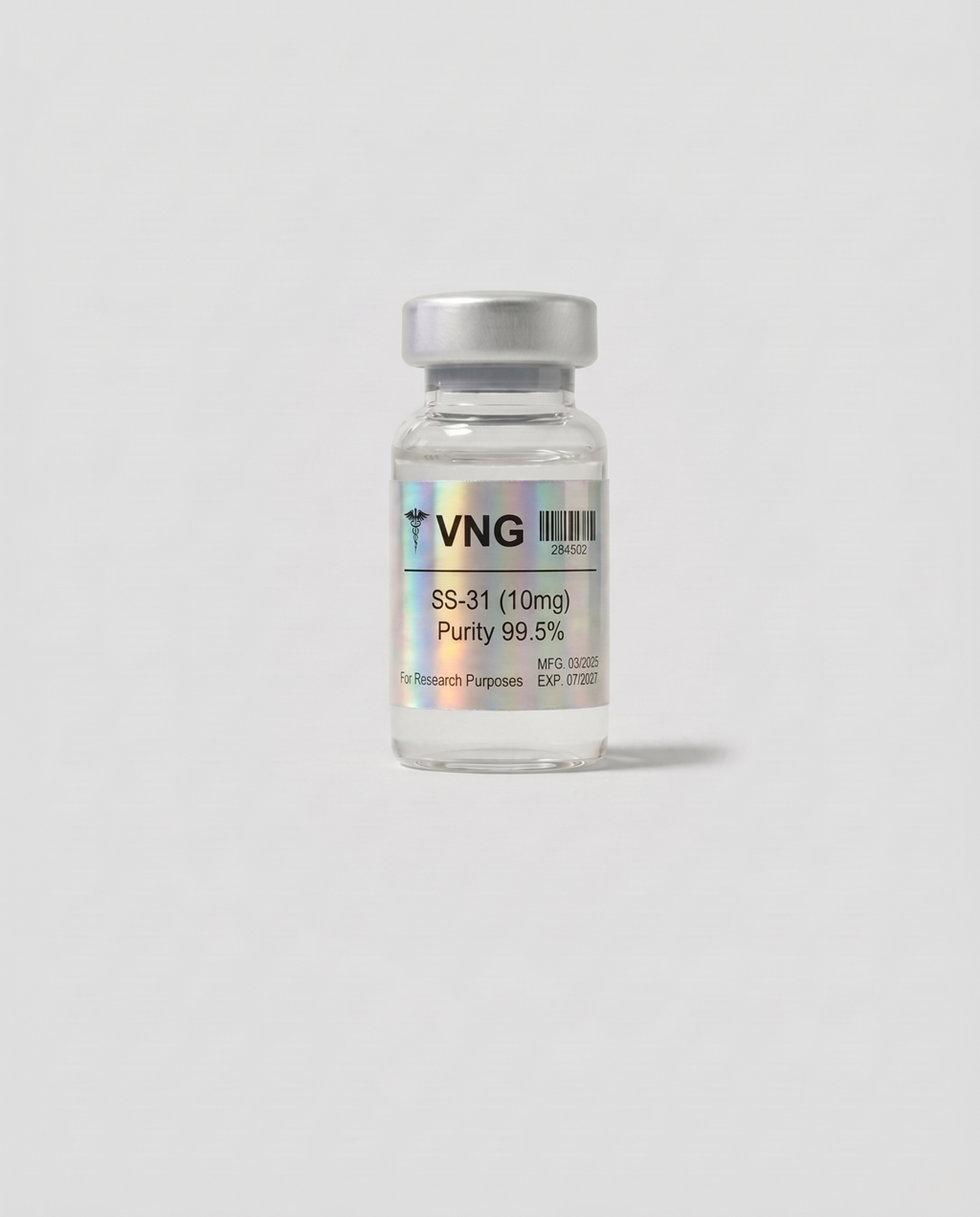
For research & educational purposes only. This article is a neutral, procedural reference for laboratory / in-vitro research handling — not medical advice or a usage recommendation. These materials are not for human or animal consumption.
On this page
What SS-31 is
SS-31 (also called elamipretide) is a small four-amino-acid peptide designed to home in on mitochondria, the energy factories inside cells. It is supplied as an analytical-grade reference material for laboratory research.
Where it comes from
SS-31 gets its name from Hazel Szeto and Peter Schiller, the two researchers whose lab designed it in the early 2000s. It belongs to a small family of 'Szeto-Schiller' peptides: short, aromatic-cationic sequences engineered to slip across cell membranes and concentrate inside mitochondria without needing the membrane's electrical charge to pull them in. SS-31 is just four amino acids long. It was later developed for clinical study under the name elamipretide, and it remains one of the best-known tools for probing mitochondrial membrane biology.
What it does — in plain terms
SS-31 is built to concentrate on the inner membrane of the mitochondria, where it binds a special lipid called cardiolipin. That membrane is where cells actually generate their energy, and it tends to become disorganized under stress or with age. By stabilizing cardiolipin, SS-31 appears to help the energy machinery stay efficient and produce fewer damaging byproducts. That targeted mechanism makes it a common tool in research on cellular energy (bioenergetics), oxidative stress, and age-related decline.
How it works
SS-31's trick is its address label. Its alternating aromatic and positively charged residues let it home in on the inner mitochondrial membrane and bind a distinctive lipid there called cardiolipin. Unlike many mitochondrial compounds, it does this without depending on the membrane's voltage, so it still reaches its target even when a mitochondrion is stressed and losing charge.
Cardiolipin is not just structural padding -- it helps shape the folded 'cristae' of the inner membrane and holds the electron-transport machinery in proper working order. By binding cardiolipin, SS-31 appears to help keep that membrane organized, which in study models translates to more efficient electron flow, steadier ATP production, and fewer leaked electrons that would otherwise become damaging reactive-oxygen species.
From that single anchoring mechanism, researchers trace a range of downstream effects: better bioenergetics in tired or aged mitochondria and lower oxidative stress. Recent laboratory work has added detail -- for example, how the peptide alters membrane surface charge and improves the handling of ADP, the raw material for making ATP.
What the research shows
SS-31 is appealing to researchers because it targets a specific, well-defined structure -- cardiolipin in the mitochondrial membrane -- rather than acting diffusely. Still, it is important to be clear-eyed: most of the evidence is preclinical, from isolated mitochondria, cells, and animal models. As the drug elamipretide it has advanced into human clinical trials for mitochondrial disorders, but results there have been mixed and firm proof of benefit is still being worked out. Here is what some of the key published work reports.
- GeroScience, 2023 — reported that SS-31 (elamipretide) improved ADP sensitivity in aged mitochondria by increasing ADP uptake through the adenine nucleotide transporter, in laboratory studies.
- Journal of Biological Chemistry, 2020 — showed that SS-31 binds lipid bilayers and shifts their surface electrostatics, offering a mechanism for how it interacts with the mitochondrial membrane and cardiolipin.
- International Journal of Molecular Sciences, 2025 — reviewed elamipretide's (SS-31) structure, mechanism of action, and therapeutic potential in mitochondrial-dysfunction research.
- Biomedicine & Pharmacotherapy, 2020 — found that SS-31 reduced cisplatin-induced acute kidney injury in animals, acting through the mitochondrial ROS-NLRP3 inflammatory pathway.
What SS-31 is studied for
Cardiolipin and membrane stability. The defining line of research is SS-31's binding to cardiolipin in the inner mitochondrial membrane, which appears to help keep the membrane's folded structure and electron-transport machinery organized.
Bioenergetics (ATP production). In isolated and aged mitochondria, SS-31 has been reported to improve the handling of ADP and support more efficient energy output, which is why it is used as a tool in bioenergetics research.
Mitochondrial oxidative stress. By helping electrons flow cleanly through the transport chain, SS-31 is studied for reducing the leaked electrons that form damaging reactive-oxygen species.
Organ-injury and aging models. Animal work has examined SS-31 in settings of mitochondrial stress such as kidney injury, and reviews frame it around age-related mitochondrial decline. These remain preclinical or early-clinical questions.
Storage & handling
As a lyophilized (freeze-dried) powder, SS-31 reference material keeps best cold and dark -- refrigerated for short-term storage, frozen for longer holds. After reconstitution with bacteriostatic water it should be refrigerated at about 2-8 C, protected from light, and shielded from repeated freeze-thaw cycles that break peptides down. Handle it strictly as a laboratory reagent, and consult the reconstitution reference below for working out concentrations.
Plain-language explanations describe what researchers study — not what any product does for a person, and not medical advice. Every material here is sold for laboratory research use only and is not for human or animal use.
Frequently asked questions
What is SS-31?
SS-31 is a synthetic four-amino-acid peptide designed to concentrate inside mitochondria, where it binds a membrane lipid called cardiolipin. It is supplied here as an analytical-grade reference material for laboratory research use only.
Is SS-31 the same as elamipretide?
Yes. SS-31 is the research name; elamipretide (also known as MTP-131) is the name used in clinical development. They refer to the same mitochondria-targeting peptide.
How does SS-31 reach the mitochondria?
Its alternating aromatic and positively charged amino acids let it cross membranes and accumulate on the inner mitochondrial membrane, binding cardiolipin. Notably, it does this without relying on the membrane's electrical charge, so it can still reach stressed mitochondria.
Is SS-31 supported by human clinical trials?
Only partly. Most published evidence is preclinical, from isolated mitochondria, cells, and animals. As elamipretide it has been tested in human trials for mitochondrial disease, but outcomes have been mixed and a clear benefit is not yet established.
How is VNG Labs' SS-31 supplied and tested?
SS-31 is provided as an analytical-grade, lyophilized reference material for laboratory research use only, with third-party testing (Vanguard) for identity and purity. It is not a drug or supplement and is not intended for human or veterinary use.
Published research
A selection of peer-reviewed and clinical literature indexed on PubMed. Provided so qualified researchers can locate the primary sources — inclusion here is not a claim about any product or outcome.
- Lab studyGeroScience · 2023
Elamipretide (SS-31) improves ADP sensitivity in aged mitochondria by increasing uptake through the adenine nucleotide transporter
View on PubMed - Lab studyThe Journal of biological chemistry · 2020
The mitochondria-targeted peptide SS-31 binds lipid bilayers and modulates surface electrostatics
View on PubMed - Peer-reviewed reviewInternational journal of molecular sciences · 2025
Elamipretide: a review of its structure, mechanism of action, and therapeutic potential
View on PubMed - Animal-model studyBiomedicine & pharmacotherapy · 2020
Mitochondria-targeted peptide SS-31 prevents cisplatin-induced acute kidney injury via the mitochondrial ROS–NLRP3 pathway
View on PubMed
References & resources
Continue reading
Related reference materials
VNG Research Team
VNG Labs supplies analytical-grade reference materials with lot-matched Certificates of Analysis. Our write-ups are neutral, source-cited references for qualified and independent researchers.
More from LearnResearch use only. Not for human consumption or veterinary use. Sold exclusively to qualified researchers for in vitro and laboratory research. These statements have not been evaluated by the FDA. Not intended to diagnose, treat, cure, or prevent any disease. Refrigerate upon receipt. Keep in dark environment.