
For research & educational purposes only. This article is a neutral, procedural reference for laboratory / in-vitro research handling — not medical advice or a usage recommendation. These materials are not for human or animal consumption.
On this page
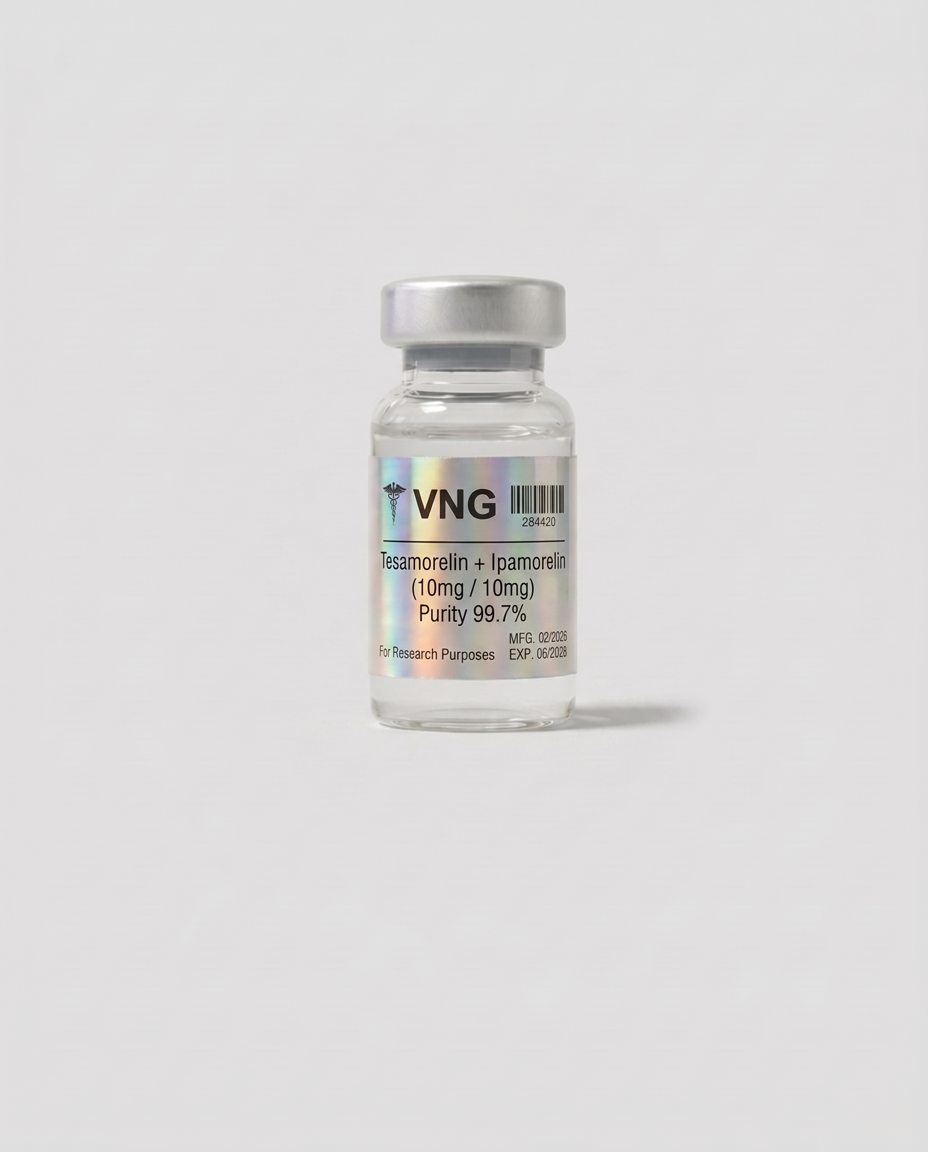
What Tesamorelin + Ipamorelin is
This blend combines tesamorelin, a stabilised analogue of growth-hormone-releasing hormone (GHRH 1-44), with ipamorelin, a five-amino-acid growth hormone secretagogue. Each is supplied as an analytical-grade reference material for laboratory research; the blend has not itself been studied and the evidence below is for the two components separately.
Where it comes from
Tesamorelin was created by adding a trans-3-hexenoic acid group to the N-terminus of GHRH 1-44, which protects the peptide from the enzyme that normally cuts native GHRH within minutes; it went on to become an approved medicine for excess abdominal fat in HIV-associated lipodystrophy. Ipamorelin came from Novo Nordisk in the 1990s as the first growth hormone secretagogue that released GH without also raising cortisol or ACTH, described in a 1998 European Journal of Endocrinology paper. Combining a GHRH analogue with a secretagogue is a research idea, not a studied product.
What it does — in plain terms
Both peptides ask the pituitary for growth hormone, but through different receptors. Tesamorelin acts on the GHRH receptor, the same one the hypothalamus uses; ipamorelin acts on the ghrelin (GHS-R1a) receptor. In research the two signals are complementary, which is why secretagogues are often studied alongside GHRH analogues, though no published study has tested this particular pair together.
How it works
Tesamorelin binds the GHRH receptor on pituitary somatotrophs and provokes pulsatile growth hormone release, with IGF-1 rising as a downstream marker. Its clinical trials measured visceral adipose tissue by CT in people with HIV-associated lipodystrophy, and a 2020 study looked at liver fat in the same population.
Ipamorelin binds the ghrelin receptor. Its defining property, from the 1998 characterisation, is selectivity: growth hormone rose while cortisol, ACTH and prolactin did not, unlike earlier secretagogues. In rats it increased longitudinal bone growth.
In principle the two routes add, because a GHRH signal and a ghrelin-receptor signal converge on the same somatotroph from different directions. That principle is established for GHRH plus other secretagogues; it has not been tested for this specific pairing, and researchers should treat the blend as two reference materials in one vial.
What the research shows
The evidence is asymmetric. Tesamorelin has a full clinical record, including approval, in a narrow indication. Ipamorelin has a solid preclinical and early human pharmacology record from the 1990s and little since. The combination has no published studies, so any statement about the blend is an inference from its parts.
- Drugs, 2011 — reviewed tesamorelin in HIV-associated lipodystrophy, summarising trials in which it reduced visceral adipose tissue over the study period with IGF-1 rising as expected.
- Nature Reviews Drug Discovery, 2011 — profiled tesamorelin at approval, describing its mechanism as a stabilised GHRH analogue and the trial programme behind it.
- JCI Insight, 2020 — studied tesamorelin in people with HIV and non-alcoholic fatty liver disease, reporting effects on liver fat and related markers.
- European Journal of Endocrinology, 1998 — characterised ipamorelin as the first selective growth hormone secretagogue: it released growth hormone without the cortisol and ACTH rise seen with earlier compounds.
- Growth Hormone & IGF Research, 1999 — reported that ipamorelin increased longitudinal bone growth in rats, an in-vivo confirmation of growth hormone release.
What Tesamorelin + Ipamorelin is studied for
GHRH-receptor signalling. Tesamorelin is the reference stabilised GHRH analogue: it survives the enzyme that clears native GHRH and provokes physiological, pulsatile growth hormone release.
Visceral fat in HIV lipodystrophy. The indication tesamorelin was approved for; trials measured abdominal visceral fat by CT and reported reductions over the treatment period in that specific population.
Selective growth hormone release. Ipamorelin's claim to fame: growth hormone up, stress hormones unchanged, which made it a cleaner research tool than earlier secretagogues.
Bone growth in animals. Rat studies showed longitudinal bone growth with ipamorelin, a downstream sign that the released growth hormone was biologically active.
Storage & handling
As a lyophilized (freeze-dried) powder the blend is most stable kept cold and dark, refrigerated or frozen for longer holds. Once reconstituted with bacteriostatic water it should be refrigerated at roughly 2-8 °C, kept out of light, and protected from repeated freeze-thaw cycles.
Plain-language explanations describe what researchers study — not what any product does for a person, and not medical advice. Every material here is sold for laboratory research use only and is not for human or animal use.
Reconstitution reference
Standard laboratory reconstitution volumes for Tesamorelin + Ipamorelin, from the VNG Reconstitution Sheet. See the full reconstitution guide for the method and concentration math.
| Product | Vial | Bacteriostatic water | Resulting concentration |
|---|---|---|---|
| Tesamorelin | 10 mg | 1 mL | 10 mg/mL |
| Tesamorelin | 20 mg | 2 mL | 10 mg/mL |
Frequently asked questions
What is in the Tesamorelin + Ipamorelin blend?
Tesamorelin, a stabilised GHRH 1-44 analogue, and ipamorelin, a selective five-amino-acid growth hormone secretagogue, together in one vial as analytical-grade reference material for laboratory research use only.
Has the combination itself been studied?
No. The published evidence is for each peptide on its own. The idea of pairing a GHRH analogue with a secretagogue comes from research on other combinations.
How do the two peptides differ?
Tesamorelin acts on the GHRH receptor; ipamorelin acts on the ghrelin (GHS-R1a) receptor. Both prompt the pituitary to release growth hormone, by different routes.
What has tesamorelin been studied for?
Mainly visceral fat in HIV-associated lipodystrophy, the indication it is approved for, and more recently liver fat in the same population.
How is the blend stored and reconstituted?
Keep the lyophilized powder cold and dark; reconstitute with bacteriostatic water, refrigerate at about 2-8 °C, and avoid repeated freeze-thaw cycles.
Published research
A selection of peer-reviewed and clinical literature indexed on PubMed. Provided so qualified researchers can locate the primary sources — inclusion here is not a claim about any product or outcome.
- Component study: tesamorelinDrugs · 2011
Tesamorelin and HIV-associated lipodystrophy (review)
View on PubMed - Component study: tesamorelinNature Reviews Drug Discovery · 2011
Tesamorelin drug profile
View on PubMed - Component study: tesamorelinJCI Insight · 2020
Tesamorelin and fatty liver in HIV (NAFLD)
View on PubMed - Component study: ipamorelinEuropean Journal of Endocrinology · 1998
Ipamorelin, the first selective growth hormone secretagogue
View on PubMed - Component study: ipamorelinGrowth Hormone & IGF Research · 1999
Ipamorelin, a new growth-hormone-releasing peptide, induces longitudinal bone growth in rats
View on PubMed
References & resources
Related reference materials
VNG Research Team
VNG Labs supplies analytical-grade reference materials with lot-matched Certificates of Analysis. Our write-ups are neutral, source-cited references for qualified and independent researchers.
More from LearnResearch use only. Not for human consumption or veterinary use. Sold exclusively to qualified researchers for in vitro and laboratory research. These statements have not been evaluated by the FDA. Not intended to diagnose, treat, cure, or prevent any disease. Refrigerate upon receipt. Keep in dark environment.