
For research & educational purposes only. This article is a neutral, procedural reference for laboratory / in-vitro research handling — not medical advice or a usage recommendation. These materials are not for human or animal consumption.
On this page
What B12 is
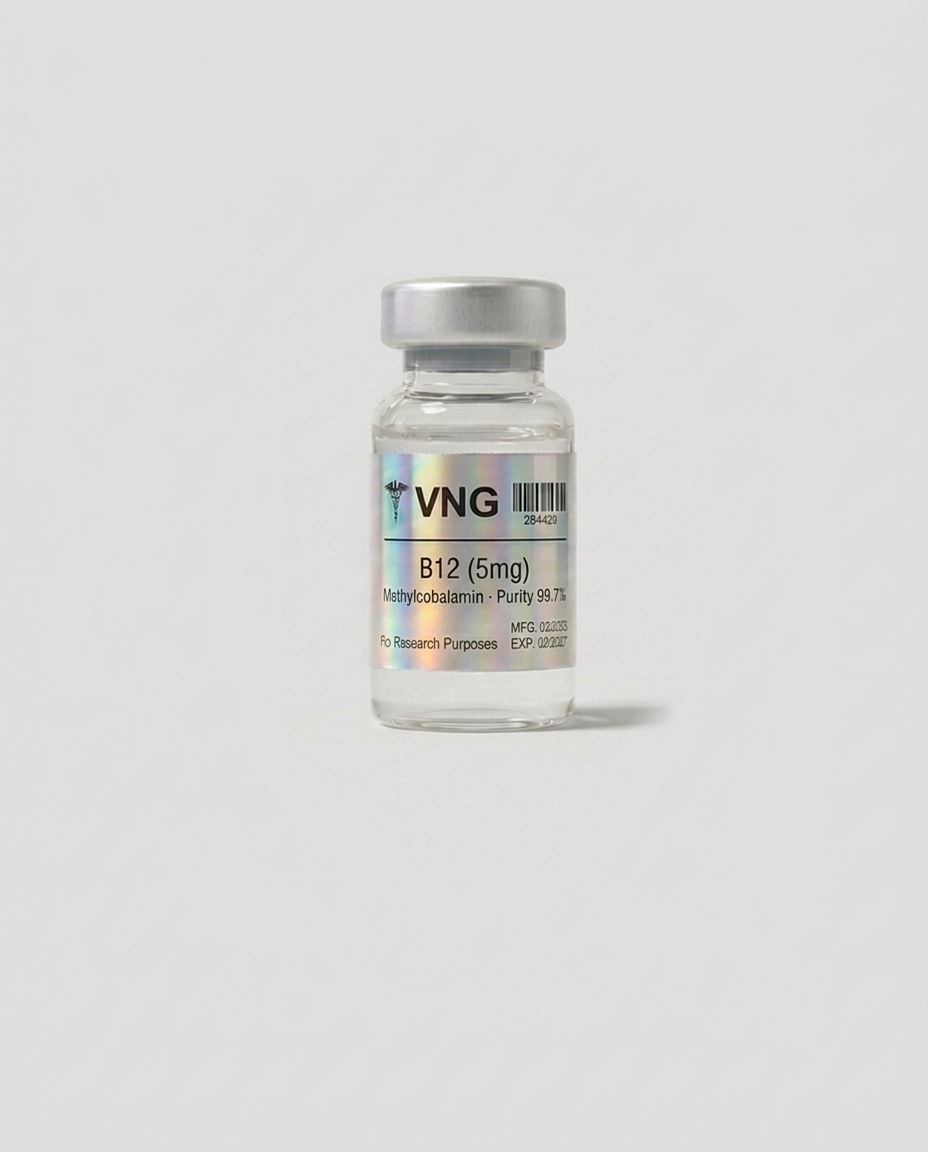
Vitamin B12 (cobalamin) is not a peptide — it is a water-soluble vitamin the body cannot make and must take in, and it works as an essential coenzyme. The form supplied here is methylcobalamin, the active coenzyme form. It is supplied as an analytical-grade reference material for laboratory research.
Where it comes from
B12 was the last vitamin to be identified, and it took a Nobel-winning effort to pin down. Pernicious anaemia was fatal until the 1920s, when researchers found that feeding liver reversed it; the active factor was finally isolated as cobalamin in 1948, and Dorothy Hodgkin solved its structure by X-ray crystallography in the 1950s — work recognised with the 1964 Nobel Prize in Chemistry. It remains the only vitamin built around a metal atom (cobalt, held in a corrin ring) and the only one that needs a dedicated carrier protein, intrinsic factor, to be absorbed at all.
What it does — in plain terms
B12 is a helper molecule that a couple of very specific enzyme reactions simply cannot run without. Its best-known job is handing off a methyl group so the body can convert homocysteine back into methionine — the reaction that keeps the cell's methylation chemistry turning over, including the upkeep of the myelin sheath that insulates nerves. A second cobalamin form supports a separate step in breaking down certain fats and amino acids. When B12 runs short, the tissues that notice first are the ones that divide fastest or depend on intact myelin — red blood cells and nerves — which is why most of the published literature centres on deficiency, nerve function, and homocysteine.
How it works
B12 works as a coenzyme in two places, and the body uses a different form in each. Methylcobalamin — the form supplied here — works in the cell fluid alongside methionine synthase, the enzyme that moves a methyl group onto homocysteine and regenerates methionine. Adenosylcobalamin works inside the mitochondria on a separate reaction in the breakdown of certain fats and amino acids.
That methionine step matters more than it sounds. Methionine feeds the cell's main methyl-donor pathway, and methylation is what maintains myelin — the fatty insulation around nerve fibres. Researchers reason that this is why nerve tissue is among the first to show changes when B12 is scarce, and it is the mechanism most often invoked in the neuropathy literature.
The other half of the story is absorption, which is unusually fragile. Dietary B12 has to be released from food protein, bound to intrinsic factor made in the stomach, and taken up in the last stretch of the small intestine. Break any link in that chain — stomach surgery, certain medications, autoimmune loss of intrinsic factor — and intake stops mattering. That bottleneck is why a large share of the research is about absorption and route rather than the molecule itself.
What the research shows
B12's evidence base is a different shape from most of this catalogue. Because it is an essential nutrient rather than an experimental compound, the trials mostly ask whether correcting a shortfall changes an outcome — not whether extra B12 does anything for someone who already has enough, which is a distinction worth holding onto when reading the results. The deficiency science is settled and long established; the nerve-related findings are real but mixed and often modest, and reviewers are explicit that trial quality varies. With that framing, here is what the key papers report.
- Nutrients, 2021 — ran a one-year randomized, double-blind, placebo-controlled trial of B12 supplementation in people with diabetic neuropathy.
- Indian Journal of Pharmacology, 2021 — compared methylcobalamin on its own against methylcobalamin combined with pregabalin, and with duloxetine, in painful diabetic neuropathy.
- Nutrients, 2020 — systematically reviewed the trials using B12 for peripheral neuropathic pain, and found the evidence base limited and uneven in quality.
- Journal of Alternative and Complementary Medicine, 2020 — pooled randomized controlled trials of mecobalamin (methylcobalamin) in peripheral neuropathy in a meta-analysis.
- The New England Journal of Medicine, 2013 — set out in a clinical-practice review how B12 deficiency presents, how it is confirmed on testing, and how it is corrected.
- Vitamins and Hormones, 2022 — reviewed B12 absorption and malabsorption, including the intrinsic-factor pathway that limits how much oral B12 actually gets in.
What B12 is studied for
Peripheral nerve function. The largest slice of the clinical literature. Trials and meta-analyses have examined methylcobalamin in peripheral neuropathy — most often diabetic neuropathy — with results reviewers describe as real but modest and drawn from trials of variable quality.
Deficiency and how it is corrected. The best-established science here. Deficiency produces a well-characterised picture in blood and nerve tissue, and the research covers how it is detected and which routes of replacement restore levels.
Homocysteine and methylation. B12 is one of the nutrients that keeps homocysteine cycling back to methionine, so it appears throughout research on methylation chemistry and on what raised homocysteine reflects.
Red-blood-cell formation. Because B12 is needed for DNA synthesis, fast-dividing marrow cells are hit early when it runs short — the origin of the enlarged red cells that made pernicious anaemia recognisable long before the vitamin itself was known.
Storage & handling
Methylcobalamin is markedly light-sensitive — more so than most materials in this catalogue — so it should be kept dark at every stage; amber vials or foil wrapping are standard laboratory practice. Keep the lyophilized powder cold and dark, refrigerate a reconstituted solution at roughly 2-8 °C, protect it from light, and avoid repeated freeze-thaw cycles. Its deep red colour comes from the cobalt atom at its centre, so visible fading is a useful sign that material has degraded.
Plain-language explanations describe what researchers study — not what any product does for a person, and not medical advice. Every material here is sold for laboratory research use only and is not for human or animal use.
Frequently asked questions
What is vitamin B12 (methylcobalamin)?
Vitamin B12, or cobalamin, is a water-soluble vitamin that acts as an essential coenzyme in human metabolism. Methylcobalamin is its active coenzyme form, the one used in the reaction that regenerates methionine from homocysteine. It is supplied here as an analytical-grade reference material for laboratory research use only.
Is B12 a peptide?
No. Unlike most of this catalogue, B12 is a vitamin, not a peptide — a cobalt-containing molecule built on a corrin ring. It is included because it is a common analytical reference standard and is frequently studied alongside these compounds.
How does B12 work in research?
B12 serves as a coenzyme in two reactions: methylcobalamin supports methionine synthase, which converts homocysteine back to methionine and keeps the cell's methylation chemistry running, and a second form supports a mitochondrial step in fat and amino-acid breakdown. The methylation route is the one usually invoked to explain why nerve tissue is affected early when B12 is scarce.
What has B12 been studied for?
Chiefly deficiency — how it presents, how it is detected and how it is corrected — plus peripheral nerve function, homocysteine and methylation, and red-blood-cell formation. Most trials test correcting a shortfall rather than adding more where levels are already adequate, and the neuropathy results specifically are mixed and modest.
How should B12 be stored?
Cold and, above all, dark — methylcobalamin degrades in light, so amber vials or foil are standard. Keep the lyophilized powder refrigerated or frozen, refrigerate a reconstituted solution at about 2-8 °C, and avoid repeated freeze-thaw cycles. Fading of its deep red colour suggests degradation.
Published research
A selection of peer-reviewed and clinical literature indexed on PubMed. Provided so qualified researchers can locate the primary sources — inclusion here is not a claim about any product or outcome.
- Human clinical trialNutrients · 2021
Vitamin B12 supplementation in diabetic neuropathy: a 1-year, randomized, double-blind, placebo-controlled trial
View on PubMed - Human clinical trialIndian journal of pharmacology · 2021
A randomized comparative study of methylcobalamin, methylcobalamin plus pregabalin and methylcobalamin plus duloxetine in patients of painful diabetic neuropathy
View on PubMed - Peer-reviewed reviewNutrients · 2020
B12 as a treatment for peripheral neuropathic pain: a systematic review
View on PubMed - Meta-analysisJournal of alternative and complementary medicine · 2020
Efficacy and safety of mecobalamin on peripheral neuropathy: a systematic review and meta-analysis of randomized controlled trials
View on PubMed - Peer-reviewed reviewThe New England journal of medicine · 2013
Clinical practice: vitamin B12 deficiency
View on PubMed - Peer-reviewed reviewVitamins and hormones · 2022
Vitamin B12 absorption and malabsorption
View on PubMed
References & resources
Related reference materials
VNG Research Team
VNG Labs supplies analytical-grade reference materials with lot-matched Certificates of Analysis. Our write-ups are neutral, source-cited references for qualified and independent researchers.
More from LearnResearch use only. Not for human consumption or veterinary use. Sold exclusively to qualified researchers for in vitro and laboratory research. These statements have not been evaluated by the FDA. Not intended to diagnose, treat, cure, or prevent any disease. Refrigerate upon receipt. Keep in dark environment.